

- What Is Changing With Google Smart Bidding in August 2026?
- Which Google Ads Campaigns Are Most Affected?
- How Will the Smart Bidding Change Affect Target CPA Campaigns?
- How Will It Affect Target ROAS Campaigns?
- Why Budget-Limited Campaigns May See the Biggest Impact
- What Advertisers Should Check After the August 17 Update
- Should You Change Your Target CPA or Target ROAS
- What Businesses Should Monitor After the Update
- How a Google Ads Agency Can Help Businesses Adapt
- FAQ’s
On August 17, 2026, Google will make changes to the way target-based bidding functions regarding budgets that limit campaigns. Once this change goes into effect, campaigns that utilize demand generation and the bidding strategies of Target CPA, Target ROAS, and Target CPC will be optimized to achieve their intended bidding targets effortlessly at all times, even if the budget is altered.
This change in algorithm aims at aligning the activities of campaigns with the targeted results. This approach is especially promising thanks to some campaigns constantly featuring results that exceed their targets due to some limitations.
As an illustration, the campaign with the target CPA of $10 while having the actual CPA of $6 is in a position to get closer to its target CPA. At the same time, it is not that Google is changing its budget and bidding strategies, but merely the algorithm that will lead to better results for the campaigns in question.
What Is Changing With Google Smart Bidding in August 2026?
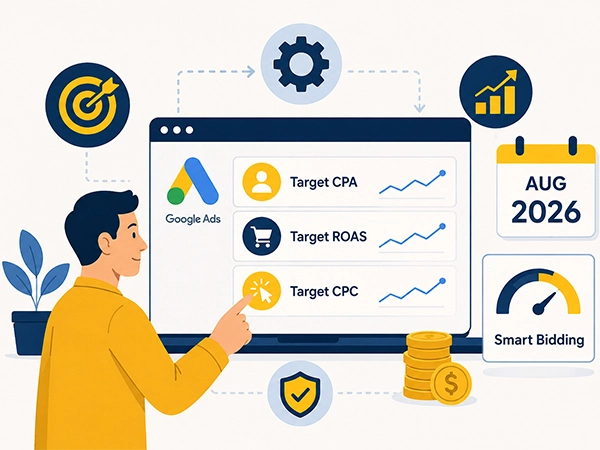
Google is revising its bidding system for campaigns whose budgets are limited and that use target-based bids. The objective is to make these campaigns work towards the target given by the advertiser more effectively, even when the budget changes. This update has started to be rolled out all over the world since August 17, 2026.
The strategies that will be most affected are:
- Target CPA: This refers to a bidding strategy which uses automation to set bids with the goal of generating a maximum number of conversions, making sure that the cost of those conversions averages around the target CPA chosen. Each conversion could cost either more or less than the target price.
- Target ROAS: It is a bidding strategy based on automation that sets the bids in a manner which allows for maxing out the conversion value while keeping the returns close to the targeted ROAS, which was specified by you. To influence the bids, automation uses the data on conversion value.
- CPC Target for Demand Generation: It is an automated bidding strategy aimed at setting the bids so that they create the maximum number of clicks while keeping the costs for those clicks as close to the target CPC as possible. The clicks may cost more or less than the target price, but Google is targeting an average cost around the target.
The most crucial thing to understand is that Google will not take it upon itself to change the strategies for you. Rather, the bidding system will be altered in terms of its behavior when it comes to campaigns whose budget is limited. This factor is especially important for cases when the campaign is consistently exceeding the targets set.
Which Google Ads Campaigns Are Most Affected?
This update does not change all of Google’s ad campaigns. The major changes will be observed in campaigns that meet two criteria: such campaigns are limited by budget, and they implement the affected target-based bidding scheme.
It is especially important to focus on the following points:
- The campaigns that employ Target CPA
- The campaigns employing Target ROAS
- Demand Gen campaigns employing Target CPC
- The campaigns that are often marked with the status Limited by budget
- The campaigns that were predominantly more successful than their goals
The update can be applied to several campaign types, such as Search campaigns, Shopping campaigns, Performance Max campaigns, Demand Gen campaigns, and Travel campaigns.
The new changes are applicable to Search campaigns, Shopping campaigns, Performance Max campaigns, Demand Gen campaigns, and Travel campaigns, all of which are administered via Google Ads or Search Ads 360. Additionally, this change can be used for Demand Gen line items that are controlled through Display and Video 360.
Nonetheless, this update only concerns campaigns whose budgets are restricted and use the affected bidding strategies mentioned earlier, namely Target Cost Per Action, Target Return on Advertising Spend, or Target Cost Per Click for Demand Gen. As part of the changes implemented, Google won’t be changing the campaign’s budget or target automatically.
The campaigns that are not restricted by budget are not the primary concern of this update. Furthermore, it does not mean that every campaign that uses Target CPA or Target ROAS would see adequate impact.
How Will the Smart Bidding Change Affect Target CPA Campaigns?
With Target CPA bidding, advertisers are given the opportunity to achieve conversion rates that are close to their defined Target CPA cost. Following the August 2026 update, budget-limited Target CPA campaigns may be able to achieve their target CPA more effectively than before.
This holds significant relevance for campaigns that have developed a CPA that is much lower than their target CPA. For example, suppose a budget-limited campaign has a Target CPA of ₹1,000 but consistently generates conversions at ₹600. After the update, the system may participate in more auctions, potentially increasing conversion volume while moving the average CPA closer to ₹1,000.
Advertisers should determine whether the additional conversions remain profitable and produce qualified leads or customers. However, that doesn’t mean that the campaign is running poorly.
It simply means that the previous performance was more efficient than the stated target to achieve. Hence, advertisers should pay attention to metrics such as actual CPA, volume of conversions, spending, and quality of leads/customers rather than gauging the change on the basis of CPA itself.
How Will It Affect Target ROAS Campaigns?
Target ROAS emphasizes the importance of revenue resulting from advertising rather than the number of conversions obtained. When determining bids, Google uses the stated conversion values on which the advertiser wants to base its average ROAS.
The new system is seeking to align the performance of campaigns with the intended Target ROAS more closely in cases when the budget is limited. The update may affect campaigns that have a history of exceeding their target ROAS by a significant margin.
For instance, if the advertiser specifies 300% as the Target ROAS and the campaign actually generates 500%, the reported ROAS may move closer to the 300% target after the update. However, the campaign could also spend more and generate greater total conversion value.
It is important for advertisers to view conversion value, spending, conversion volume, and ROAS simultaneously. A lower actual ROAS does not necessarily mean weaker overall performance if the campaign generates more profitable conversion value. .
On the contrary, high target ROAS can indicate that the campaign strategy is too conservative and it misses out on expansion opportunities. It is worth noting that conversion tracking and conversion values are especially critical for Target ROAS campaigns, because the functioning of the bidding system relies on the data provided.
Why Budget-Limited Campaigns May See the Biggest Impact
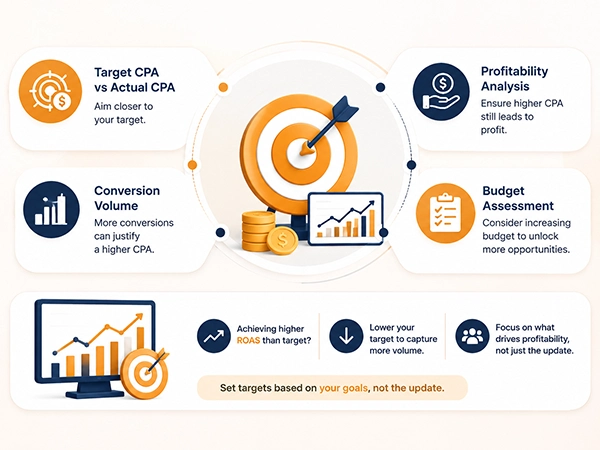
When a campaign is classified as Limited by budget, it means that the campaign is limited by the daily budget that they have at its disposal. While there may be opportunities beyond that budget, the campaign is not able to pursue these options based on its budget restraints.
With the new change in bidding strategy, budget-limited campaigns with a consistent success rate may benefit the most. Ad buyers are encouraged to analyze:
- Target CPA versus actual CPA: If the campaign was targeting a CPA of $10, but was able to consistently achieve a CPA of $5, it means that it will start getting closer to its intended target.
- Conversion volume: A higher CPA can be acceptable if it leads to a higher number of conversions.
- Profitability analysis: Check if more conversions resulting in the CPA increase would still make a profit.
- Budget assessment: Is there an option to increase budget in order to gain new productive options?
The same concept applies to Target ROAS. If a campaign is consistently achieving a higher ROAS than its stated target, advertisers can consider lowering the target if they want to maintain their current performance and potentially capture more volume. However, the right target should ultimately be based on the campaign’s profitability goals rather than the August 17 update alone.
What Advertisers Should Check After the August 17 Update
Even though August 17 has passed and the implementation is ongoing, the aforementioned evaluations can still be beneficial for campaigns that have not implemented the new process yet. With that in mind, Google recommends checking all campaigns that use target bids.
1. What is your current Target CPA or Target ROAS?
Make a note of the target that you currently have for the affected campaigns. Do not change it merely because Google has introduced its new process.
2. What is your Actual CPA or ROAS?
Check how your targets measure against your performance. A big difference may require looking into whether the target continues to suit your business purposes.
3. What campaigns experience budget limitations?
Identify campaigns marked “Limited by budget.” These campaigns may be missing eligible traffic or conversion opportunities because their available budget is restricting delivery.
4. Is conversion tracking used?
Ensure that your conversions are tracked accurately. Inaccurate tracking may lead to getting misleading information, which will hinder the Smart Bidding process.
5. Conversion Quality
In any lead generation campaign, check if your conversions have resulted in qualified leads and sales. A low cost per acquisition (CPA) may not be good if the leads are of low quality.
6. Recent Performance of Campaigns
Think in terms of weeks or months and not just days. The analysis should include recent performance as compared to a relevant historical period so that some fluctuations do not generate needless actions.
7. Changes in the Campaigns
Keep records of recent changes made to budgets, goals, conversions, landing pages, or campaign settings. When doing this, it becomes easy to distinguish the effect of Google’s update from other factors causing the change in performance.
How Google’s Bid Target Adjustment Tool Works
The Bid Target Adjustment Tool has been launched by Google in order to assist advertisers in monitoring and updating targets influenced by the changes in bidding that occurred in August 2026. The tool shows the campaigns that qualify for adjustment and also provides suggestions for target changes based on the data gathered in recent times.
Thus, should you have a campaign with a Target CPA of $10, yet realizing a steady $5 CPA, the tool can suggest adjusting your target to a level closer to $5. Moreover, Google provides the option of entering personal targets that suit business requirements better.
At the same time, it should be noted that the use of the tool is not obligatory. If your current Target CPA or Target ROAS corresponds to your profitability aim, you do not need to change anything. Additionally, the changes in targets or in budgets do not occur automatically.
Should You Change Your Target CPA or Target ROAS
No. Marketers should not alter their target based solely on the August 2026 update.
The right target should be determined by the economics of the business rather than only by taking the historical average of the campaign into account. In the case of Target CPA, it is important to establish the value of a qualified lead or customer for the business. For Target ROAS, it is worth taking into account the margins and customer value as well as how much revenue needs to be generated for advertising purposes.
A swift target adjustment can be appropriate when the target does not match the business goals. It can also be considered when the campaign with a limited budget is doing better than expected, and the business is ready for more volume.
At the same time, do not rush and change the target based on only a few days of gathered data. Google suggests assessing the results from a long-term perspective, especially after changing the budget. Advertisers should also take into account that it usually takes one or two conversion cycles to measure the impact of a budget increase on campaign performance.
What Businesses Should Monitor After the Update
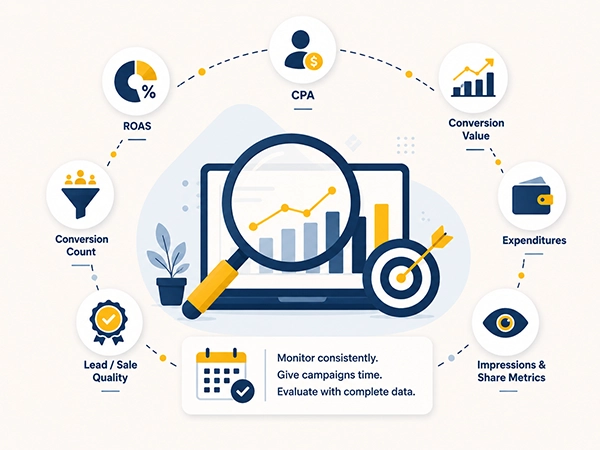
When a new bidding strategy has been implemented on a campaign, do not evaluate its effectiveness based on only one metric.
Make sure you always measure:
- Cost per acquisition (CPA): Is the CPA approaching its target?
- Return on advertising spending (ROAS): Is the advertising still effective?
- Conversion count: Are we gaining or losing conversions?
- Conversion value: Is the campaign bringing genuine revenue/value?
- Expenditures: Is the spending behavior different?
- Impressions and share metrics: Are we gaining or losing impressions and impression share?
- Lead/sale quality: Are the conversions bringing business results?
According to Google, the aim of the change is to make the bidding performance more consistent towards the goals; however, it might occur that some deviations concerning traffic and performance may happen.
Furthermore, as the updates are relevant, two identical campaigns may not implement them at the same time. It is important to give campaigns enough time to obtain the necessary conversion data before using the bid.
How a Google Ads Agency Can Help Businesses Adapt
Companies impacted by the update should evaluate their campaigns to see if there is a need to make any changes. This means looking into what exactly limits their campaigns due to the budget and comparing the actual CPA or ROAS against their targets.
A Google Ads agency can assist with this process by analyzing the bid strategies, conversion tracking, budget limits, and campaign performance. However, it is important to note that the update does not imply that all businesses should immediately make changes to their bidding strategy. Any changes must be based on campaign results and the desired profitability.
FAQ’s
What is changing in Google Smart Bidding in August 2026?
Google is updating target-based bidding for budget-limited campaigns so performance can align more consistently with the advertiser’s Target CPA, Target ROAS, or, for Demand Gen, Target CPC.
Does the update affect all Google Ads campaigns?
No. The primary change affects campaigns that are Limited by budget and use an affected target-based bidding strategy. It is not a universal change to every Google Ads campaign.
Will Target CPA campaigns become more expensive?
Not necessarily. Campaigns that previously outperformed their Target CPA may move closer to that target, which could mean a higher actual CPA. Google does not automatically increase your budget.
Should I change my Target CPA after August 17?
Only if your current target does not reflect your business goals. Review recent CPA, profitability, conversion quality, and available growth opportunities before changing it.
Will the update affect Target ROAS campaigns?
Yes. Budget-limited campaigns using Target ROAS are included. Campaigns that have been substantially outperforming their target may see performance move closer to the stated ROAS.
What does budget-limited mean in Google Ads?
It means Google’s system estimates that the campaign’s available budget is restricting its ability to capture all available traffic or opportunities. A campaign can still perform successfully while being limited by budget.
What should advertisers monitor after the update?
Monitor CPA, ROAS, conversion volume, conversion value, spend, relevant impression or share metrics, and conversion quality. Evaluate these metrics together rather than reacting to one short-term change.