
- Break-Even CPL at a Glance
- What Is Break-Even CPL?
- Why CPL Alone Can Fool You
- The Break-Even CPL Formula
- How to Calculate Break-Even CPL Step by Step
- Break-Even CPL Examples for Indian Businesses
- How to Set Your Target CPL in Google Ads
- How to Use Your Target CPL in Google Ads
- Should You Include Customer Lifetime Value (LTV)?
- Where to Find the Numbers for Your CPL Calculation
- What to Do If Your Google Ads CPL Is Above Break-Even
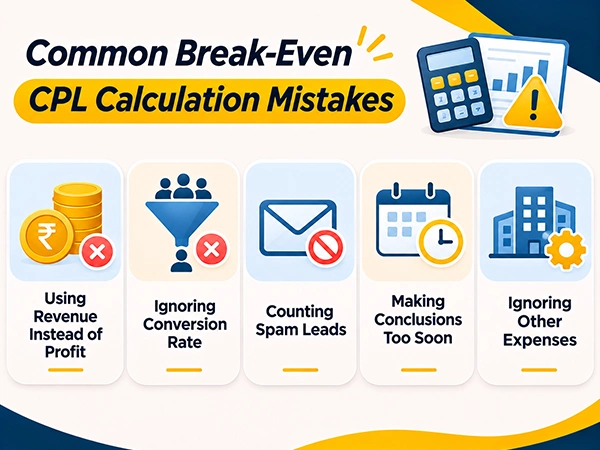
- Common Break-Even CPL Calculation Mistakes
- Frequently Asked Questions
- Conclusion: Calculate Your Break-Even CPL Before Scaling Ads
Say your Google Ads cost per lead (CPL) is ₹800. Is that good or bad? The answer is “it depends,” as the profits made from each customer, as well as the number of leads that turn into customers, have to be considered.
A business that gets one customer from every five leads has a different break-even CPL than a business that gets one customer from every fifty leads. Without these numbers, it is hard to tell whether your advertising budget is working.
Calculating your own Google Ads break-even CPL will allow you to determine the maximum cost per lead you can afford without losing money on advertising. In this article, we will explain the formula and go through the calculations step-by-step. We will also include examples related to clinics, coaching institutes, and B2B service companies in India.
QUICK ANSWERBreak-even CPL = Profit per customer × Lead-to-customer conversion rate.
This formula helps businesses calculate the maximum amount they can spend to generate a lead without losing money on advertising. For example, if the profit per customer is ₹10,000 and the conversion rate is 5%, the break-even CPL is ₹500.
Break-Even CPL at a Glance
| Metric | Example Value |
| Profit per customer | ₹10,000 |
| Lead-to-customer conversion rate | 5% |
| Break-even CPL | ₹500 |
| Target CPL | ₹300 |
What Is Break-Even CPL?
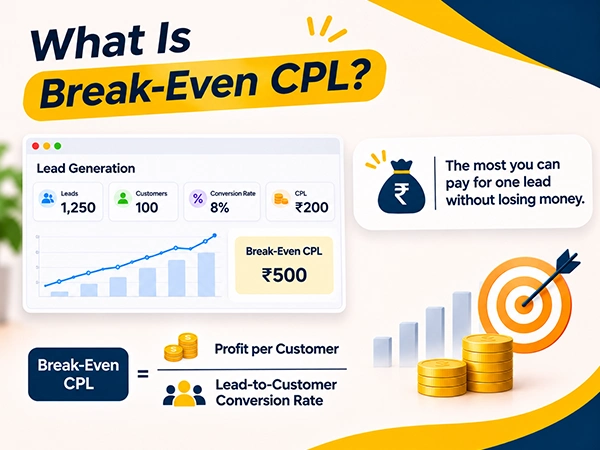
The break-even cost per lead (CPL) is the most you can pay for one lead without losing money. To find it, you need two numbers: the profit you make from each customer and the share of leads that become customers.
In other words, spending more than this amount on generating one lead may negatively affect profitability if other cost figures and conversion rate remain unchanged.
Why CPL Alone Can Fool You
CPL indicates the sum paid to secure a lead from advertising. Nonetheless, it falls short of revealing the probability of it being converted into an actual customer and the value of sales generated.
For example, consider two businesses running Google Ads with different approaches. One pays ₹300 per lead, but only 1% of its leads become paying customers. The other pays ₹900 per lead, and 10% of its leads become paying customers. Assuming that both businesses generate ₹10,000 profit per customer from the sales, the break-even CPL for the two businesses turns out to be ₹100 and ₹1,000, respectively.
The first business pays ₹300 per lead but can only afford ₹100, so it loses money. The second pays ₹900 per lead but can afford ₹1,000, so it stays profitable.
As you can see, it is important to evaluate the quality of leads in conjunction with advertising costs. Inquiries from individuals unable to afford your products, coming from outside of your operational area, or lacking the seriousness to buy anything can lead to an increase in the lead numbers without an actual sales increase.
Example: An instance would be a South Delhi salon that only provides service to clients from Saket, Hauz Khas, or Greater Kailash but receives inquiries from those in Noida, Ghaziabad, or Faridabad. By generating an extra cost per lead for the salon without a corresponding growth in its bookings and revenue, these leads will constitute an area outside its service area.
The Break-Even CPL Formula
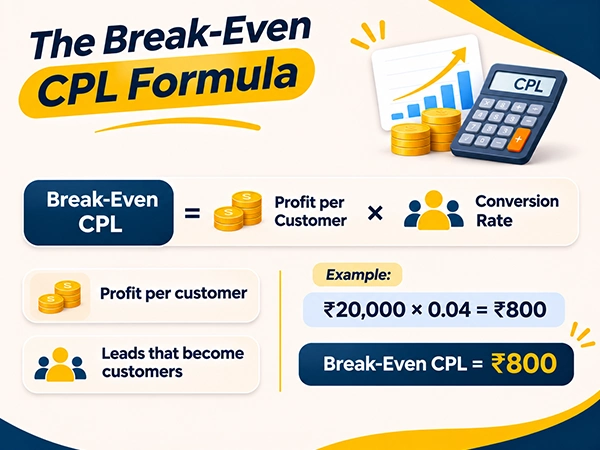
Break-even CPL is the point where your ad cost per lead equals the profit each lead brings back.
Break-Even CPL = Profit Per Customer × Lead-to-Customer Conversion Rate
The calculation is very simple, and you need only two variables.
Profit per customer is the amount of money left after making a sale, excluding advertising costs.
Lead-to-customer conversion rate is the percentage of leads that were turned into customers.
Remember to convert the conversion percentage into a decimal number.
For example, if your profit is ₹20,000 and the conversion is 4%, the calculation is:
₹20,000 × 0.04 = ₹800
Your break-even CPL is ₹800. At ₹800 per lead, your ad spend equals your profit, so you break even.
How to Calculate Break-Even CPL Step by Step
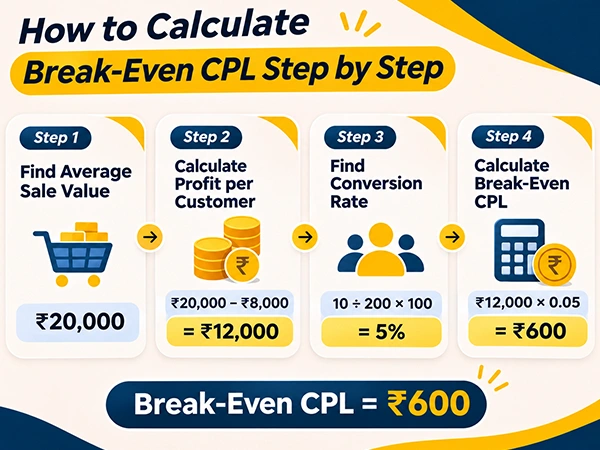
To determine the upper limit on the cost of a Google Ads lead, follow these four steps.
Step 1: Find Your Average Sale or Deal Value
You should first calculate how much each of your customers usually spends with your business.
In the case of a clinic, for instance, this could represent the typical worth of a treatment package. In the case of a coaching institute, this might mean the tuition fee of the course. In the case of a B2B organization, this could refer to the average contract value.
Make sure that you refer to the exact sales figures, rather than relying on your highest price of services. If your business offers various services at different price points, try to come up with a more realistic estimate of the average amount spent by your clients obtained through advertising channels.
Step 2: Calculate Profit Per Customer
Revenue and profit are not the same thing. Before determining the break-even cost per lead (CPL), it is essential to subtract the costs for servicing the sale from the revenue being made.
Suppose a customer pays ₹20,000 for the service. The service delivery costs relate to the rendering of the service and amount to ₹8,000. Thus, the profit in this case is as follows: profit per customer = revenue – costs = 20,000 – 8,000 = ₹12,000.
The profits amounting to ₹12,000 should be used to cover advertising and any other expenses.
It is important to take into consideration variable costs such as materials used, service delivery expenses, commissions, credit card fees, and other costs incurred upon acquiring another customer. If one wants to calculate true business profitability, it is essential to account for fixed costs such as rent and salaries as well.
Step 3: Find Your Lead-to-Customer Conversion Rate
The conversion rate from a lead to a customer indicates how many leads were converted into customers. The calculation goes as follows:
Lead-to-Customer Conversion Rate = The number of customers ÷ Total number of leads × 100
Say you got 200 leads in a month and 10 of them became customers. The calculation is:
10 ÷ 200 × 100 = 5
Thus, the conversion rate from lead to customer amounts to 5%.
Make sure you use your CRM, sales, or lead tracking solution data, and if possible, compare the leads that came through the same ad campaign and gave the customers enough time to go through your usual sales cycle.
Step 4: Calculate Your Break-Even CPL
Now, take the profit from each customer and multiply it by the lead-to-customer conversion rate represented in decimal form.
Let’s say the profit for each customer is ₹12,000 and the conversion rate is 5%.
Now, if we multiply ₹12,000 × 0.05, we get ₹600.
Hence, we now have the break-even cost per lead (CPL) of ₹600.
At ₹600 per lead, 200 leads cost ₹1,20,000. 10 customers × ₹12,000 = ₹1,20,000 profit. The ad spend and the profit are equal, so the business breaks even.
Break-Even CPL Examples for Indian Businesses
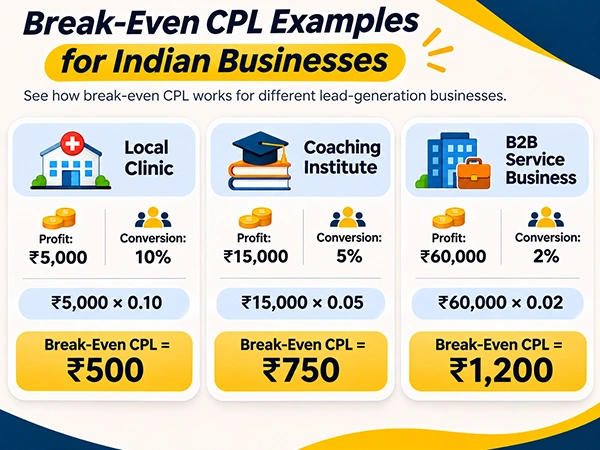
The following examples illustrate how break-even CPL works across three common lead-generation businesses. These figures are hypothetical and are not industry benchmarks or promised advertising results.
Example 1: Local Clinic
A clinic in Dwarka, Delhi earns ₹5,000 profit from each new patient. Out of every 10 inquiries, 1 becomes a patient, so the conversion rate is 10%.
Break-even CPL = ₹5,000 × 0.10 = ₹500
The clinic can pay up to ₹500 per inquiry. Above ₹500, each inquiry costs more than it brings back.
Example 2: Coaching Institute
Picture a coaching center in Rohini, Delhi that earns ₹15,000 profit from each student enrolled. The center’s conversion rate, or percentage of inquiries received – turned into paying enrollments – stands at 5%.
It works out to a break-even cost per lead of ₹15,000 × 0.05 = ₹750
With every student bringing in a greater profit margin than in the previous example, this center is able to handle a higher CPL (cost per lead). Note that the calculation has to rely on actual enrollments and not just phone calls, appointment bookings, or web-based form-filled submissions.
Example 3: B2B Service Business
Say a service company in Karol Bagh, Delhi earns ₹60,000 profit from each new client. Its sales team turns 2% of leads into clients.
Thus, the break-even cost per lead (CPL) will equal ₹60,000 x 0.02 = ₹1,200.
A CPL up to ₹1,000 is safe. Above ₹1,200, the business loses money. The business should also think about its sales cycle, payment collection, and contracts that may be delayed or canceled.
How to Set Your Target CPL in Google Ads
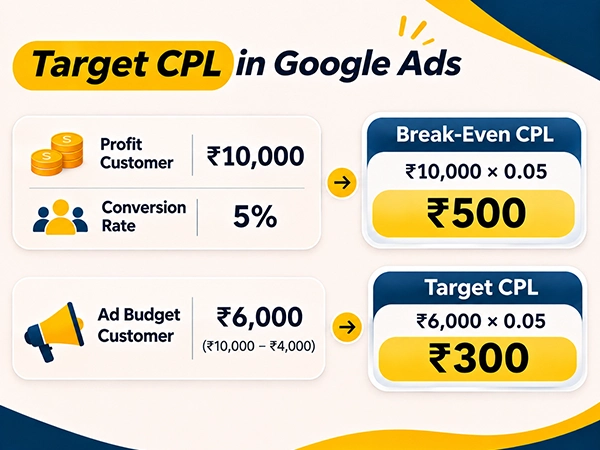
The break-even cost per lead is the highest amount you are able to spend for each lead according to your calculations. However, this isn’t a set aim for your business.
If you want to make profits, the target cost per lead must ensure you have enough funds for advertising costs and other expenses that were not included before.
Let’s take the break-even cost per lead and work back to the profit you want per customer.
Let’s say your profit per customer is ₹10,000, and your lead-to-customer conversion rate is 5%. The break-even cost per lead in this case will be ₹500.
Now, if you would like to keep ₹4,000 per customer after the advertising costs, you have ₹6,000 per converted customer for advertising.
Your target cost per lead will be:
₹6,000 × 0.05 = ₹300
At the cost per lead of ₹300, the advertising cost per customer will equal ₹6,000, which means you will have ₹4,000 left from the original profit of ₹10,000 without any other expenses considered.
How to Use Your Target CPL in Google Ads
After calculating your break-even CPL, set a Target CPA below that amount to guide Google Ads bidding towards more affordable conversions. Target CPA is an automated bidding strategy that aims to achieve an average cost per conversion, not a guaranteed cost per lead.
For example, if your break-even CPL is ₹500, you can set a Target CPA of ₹300. Google Ads will use this target to optimize bids and aim to generate leads at an average cost of ₹300.
Safe-start tip: Start with a Target CPA close to your current average CPL. Once your campaign gathers sufficient conversion data, gradually lower the target. Setting it too low initially may restrict lead volume.
Quick example:
- Break-even CPL: ₹500
- Target CPL: ₹300
- Google Ads Target CPA: ₹300
This gives Google Ads a bidding target below your break-even point. However, actual costs per lead may vary depending on campaign performance.
Should You Include Customer Lifetime Value (LTV)?
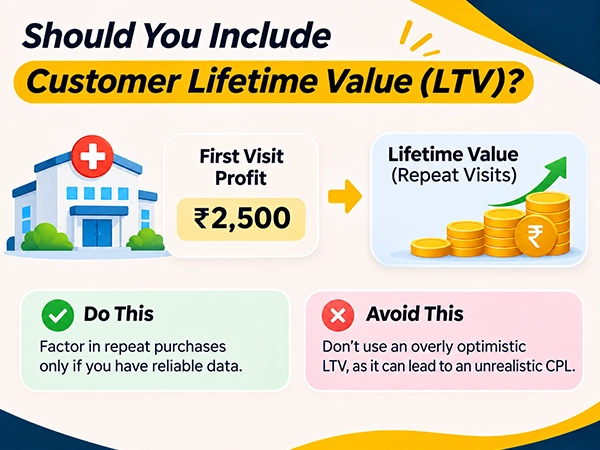
The value generated by a customer from their transactions with your business is referred to as customer lifetime value (LTV).
If customers buy from you multiple times, or use your services repeatedly, or renew their subscription with you, their lifetime value may be even higher than the profit generated through their first purchase.
For instance, a hospital may generate ₹2,500 in profit from a customer during their first visit, but if that customer continues coming to the hospital for treatment, then the total profit generated by that customer will be higher.
However, you should only count the future purchases if you have solid proof that the customers come back to your business. You also should factor in the costs associated with serving that customer, time to generate revenue, and the number of customers that stop purchasing.
Having an overly optimistic LTV will lead you to set an unrealistic CPL. For your new campaign, start with the profit from the first purchase and make further calculations when you have reliable data on the number of repeat purchases.
Where to Find the Numbers for Your CPL Calculation
Your calculation is only as reliable as the information behind it. Collect these three sets of data before deciding on a target CPL.
- Google Ads: Use the Campaigns report in order to compare advertising costs, conversions and cost per conversion among different campaigns. Track leads by either importing CRM data or creating qualified lead conversions. Also, import actual conversions to calculate cost of customer acquisition (CAC). Compare metrics in order to understand what campaigns deliver cheap leads, which have higher chances to become paying customers.
- CRM and sales records: Track how many leads become qualified prospects, receive an offer, and become paying customers. This information helps you calculate your lead-to-customer conversion rate.
- Call tracking and sales teams: If customers contact you by phone or WhatsApp after clicking an ad, make sure these inquiries are recorded consistently. Ask the sales team to identify genuine prospects, duplicate inquiries, spam, and leads that eventually purchase.
Before making major budget decisions, verify your conversion tracking. Duplicate conversions, missing calls, incorrectly configured forms, or untracked sales can distort your results.
If your conversion data is incomplete, treat your break-even CPL as an estimate until you have enough reliable information.
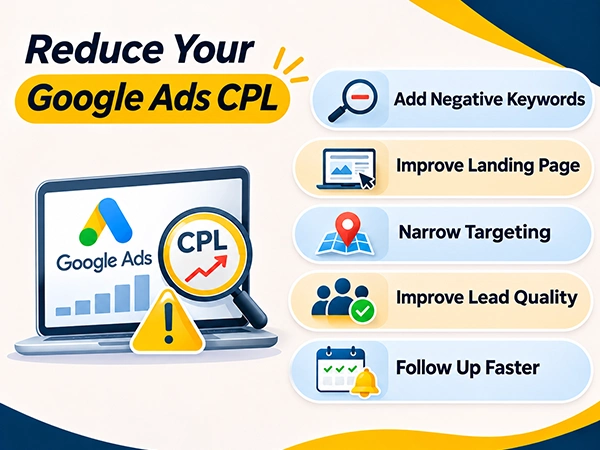
What to Do If Your Google Ads CPL Is Above Break-Even
If your current cost per lead (CPL) is more than your break-even point, allocating more funds will not be effective in solving the problem. Take a close look at the performance of your campaign to see if you can make cuts or improve the conversion rates.
1. Add Negative Keywords
Negative keywords will make your ad not appear in searches that do not match your company. Go over the reports carefully and filter out the inquiries of people looking for free services, employment, or other irrelevant things.
Be cautious in excluding keywords and do not exclude useful search terms.
2. Improve Your Landing Page
Your landing page should inform people about the services you provide, the person for whom they are intended, and the precise call to action. The contact form should be simple to fill out and informative, while the page itself should also work properly on mobile devices.
Our conversion rate optimization services can help fix this
3. Narrow Your Location and Audience Targeting
If you operate in a specific city or region, find out whether your ad is attracting potential customers who belong to your area of operations. Look into your location settings, search popularity, and the performance of your audience before limiting the targeting.
A smaller audience does not necessarily mean a better audience. You should aim to reach relevant leads rather than simply suppressing the overall number of impressions.
4. Improve Lead Quality
A low cost per lead (CPL) is meaningless if the majority of your leads are from outside your market. Spend some time reviewing your qualification process, form questions, ad messages, and your services.
Track qualified leads and paying customers separately for each campaign. This shows which campaigns bring fewer leads but more paying customers.
5. Follow Up With Leads Faster
Delayed follow-up can cause potential customers to lose focus or approach your competitors instead. Develop a concise plan for contacting prospects, tracking their responses, and arranging follow-ups at specified intervals.
Test if speeding up the follow-up process results in an actual success rate. Do not expect each extra contact to become an actual purchase.
If your cost per lead stays above break-even, a PPC audit of your keywords, bidding, tracking, and landing pages can show the reason.
Common Break-Even CPL Calculation Mistakes
Even a simple formula gives wrong results if the inputs are wrong. Avoid these mistakes:
Using revenue instead of profit: Sales of ₹20,000 do not mean that you have ₹20,000 to spend on advertising. Before calculating CPL, deduct the relevant delivery costs.
Ignoring lead-to-customer conversion rate: The conversion rate defines how valuable each lead is. Always use actual sales data if available, rather than assuming that all leads will become clients.
Counting spam leads as real leads: Spam, duplications, and irrelevant inquiries will make the CPL very appealing, although the real cost of customer acquisition can be much higher.
Making conclusions too soon: A small leads volume can give a wrong conversion rate. The length of the sales cycle, the volume of leads, and the time of the decision need to be known before the targets are changed.
Ignoring other business expenses: Breaking even with respect to advertising does not mean that the business is profitable as a whole. Make sure to take relevant overheads into account.
Frequently Asked Questions
What is the difference between CPL and CPA?
CPL (cost per lead) is what you pay to get one enquiry or contact from a potential customer. CPA (cost per acquisition) is what you pay to get one customer. In Google Ads, CPA means cost per conversion. If your conversion is a lead form, CPA and CPL are the same number.
What Is a Good CPL in Google Ads?
A good CPL can differ depending on the industry, profitability margins, conversion rates, and customer value. Hence, what may be an expensive lead for one company may be profitable for another. Therefore, it is important to work out break-even CPL first and only after that set the goal, which will leave room for profit. Using only the industry average is not enough to determine if your campaign is profitable.
How Do I Find My Lead-to-Customer Conversion Rate?
You must take the number of customers you have and divide it by the total number of leads, then multiply it by 100. If there are, for example, 15 customers out of 300 leads, it means your conversion rate is 5 percent. You must use the right sales data and CRM systems and give your leads enough time to go through the process.
Is CPL or ROAS Better for Google Ads?
Use CPL when your goal is leads, such as calls and form fills that your team follows up on. Use ROAS when you sell online and can track revenue from ads directly. Whichever you use, check it against your profit margins and other costs.
How Often Should I Recalculate My Break-Even CPL?
Recalculate it whenever your prices, delivery costs, conversion rate, or customer value change. Also review it at least once every quarter, and check your campaign results before making budget decisions.
Conclusion: Calculate Your Break-Even CPL Before Scaling Ads
Break-even cost per lead gives you the most you can pay for one lead in Google Ads. To find it, multiply your profit per new client by your lead-to-customer conversion rate.
Use real sales data and costs, and set a target CPL below the break-even level. This keeps your profit safe. Once you set the right target, check lead quality, conversion tracking, and campaign performance before you increase your budget.
If you need help finding your break-even CPL, improving lead quality, or auditing your Google Ads account, get a PPC audit from Battersea Web Expert.
Before
After