

- What Did Google Actually Say About SEO for AI Overviews and AI Search?
- Has Google Changed the Fundamentals of SEO?
- How AI Overviews and AI Search Are Changing the Search Experience
- SEO vs AI SEO: What Has Actually Changed?
- How Should Businesses Optimize for Google AI Overviews?
- Should Businesses Change Their SEO Strategy in 2026?
- How Businesses Can Measure Visibility in AI Search
- What This Means for Businesses Looking to Improve AI Search Visibility
- FAQ’s
The evolution of Google Search is due to the growing importance of AI in information discovery. In 2025, Google reported that AI Overviews had over 1.5 billion users every month across over 200 countries. In fact, in a number of core markets such as the USA and India, Google also reported more than 10% growth in Google usage for the types of queries that show AI Overviews.
This means that now people can ask longer and more complicated questions and get AI-generated answers with links to the relevant websites. Also, new AI features can carry out various kinds of users’ queries referred to as ‘query fan-out’ by running multiple related searches across different subtopics and data sources.
The positioning of Google is very clear, as the company says that AI search technology does not replace standard SEO procedures.
AI Search technologies still depend on the search systems used in Google, and such SEO-related elements as crawlability, indexing, technical accessibility, useful content, and a great page experience are relevant as well. Google confirms that no special requirements are needed specifically for AI Overviews and AI Mode.
What Did Google Actually Say About SEO for AI Overviews and AI Search?
Google’s guidance makes one thing clear: businesses do not need a separate set of SEO rules to appear in AI Overviews or AI Mode. Instead, the same strong SEO fundamentals that help pages perform in traditional Search continue to matter in AI-powered search experiences.
Google’s Search guidelines provide a special section on generating AI products, whereby the company’s message declares that existing guidelines of SEO remain valid. This section deals with various aspects of the topic, including such points as creating original content excluding cheap content that can be found anywhere, creating local and shopping information, as well as providing images and videos.
Such points are important because there have been a lot of discussions on AI SEO technology suggesting that this technology comes with special demands.
AI Overviews and AI Mode Still Depend on the Web
Google has expanded its capabilities to utilize AI in search, but they still rely on information from the web. Google provides links to relevant pages on the web within its AI experiences as a means of furthering the user’s search experience. Google has also been testing its ability to provide users with access to the information sources used to generate the AI answers.
Query fan-out allows Google’s AI systems to run multiple related searches across d different subtopics and data sources. The results can then be combined to help produce a more complete response to a complex query.
Although the ability to search for answers using complicated queries through AI is new, it does not change the fact that websites must still possess the information that Google finds useful.
What Google Has Not Said
Google has never suggested that websites should:
- create a separate AI version of each page
- add any special AI-related keywords to web content
- have all information presented in a question-answer format
- publish an llms.txt or other machine-readable AI text file in order to appear in Google AIfeatures
- stop common keyword research
- use generative AI optimization instead of existing SEO
- use a special schema specifically to guarantee AI Overview inclusion
Google says that new machine-readable or AI text files are not required for AI features.
It is crucial to note that AI search changes the way that Google retrieves and delivers information, but it does not mean that there is a fresh new checklist to follow in lieu of search engine optimization.
Has Google Changed the Fundamentals of SEO?
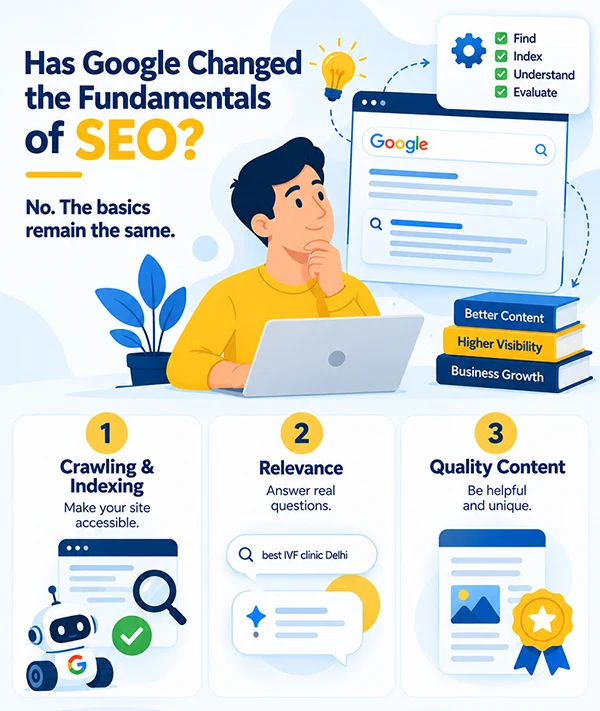
No. The basics have remained essentially the same.
Google still has to be able to find pages, index them, understand what they contain, and check if they are suitable and valuable for responding to the query of the user. Thus, technological accessibility, indexability, helpful content, clear site architecture, and strong relevance stay basic.
Google’s own recommendations about using generative AI confirm once again the importance of standard SEO guidelines.
Crawling and Indexing Still Come First
If Google cannot access a page, it cannot significantly contribute to its search system.
Therefore, companies have to check:
- if important pages respond with a successful HTTP status;
- if Googlebot is able to see them;
- if key resources are blocked accidentally;
- if everything concerning canonicalization is correct;
- if significant pages are linked to each other;
- if pages created for the purposes of SEO can be indexed;
- if the presence of duplicate low-value pages creates problems for indexing;
- if the content created with the help of JavaScript is available for Google’s rendering system.
These issues are not ‘old SEO’ concerns that are based on outdated ideas. These things are necessary in order to be visible in the search.
Relevance Still Matters
Google must still see if a webpage is pertinent to what a user is asking for.
What has changed is how detailed a user can be in articulating their request.
For example, a typical user might input:
“best IVF clinic Delhi”
An AI user will ask like this:
“Which IVF clinics in Delhi treated patients who went through failed IVF treatment previously, and what criteria should I follow in making the best selection?”
There are many concepts, restrictions, and implied questions in the second query. Websites that provide real information about IVF clinics, among other topics, can be much more relevant for one or more steps of their search journey.
This fact gives importance to the topic depth—not because Google has established the “topical authority score” to be improved, but because being thorough allows search systems to have more information to work with.
Website Quality Still Matters
A website may follow technical SEO best practices, but it is unlikely to perform well if its content is repetitive, irrelevant, or simply uses more keywords without providing real value to users.
Google’s guidelines still insist on the importance of content being valuable to users.
In other words:
The presence of AI technology does not improve the value of poor content. Instead, it makes it necessary to focus more on the content’s quality.
How AI Overviews and AI Search Are Changing the Search Experience
The most significant modification is not solely related to the ranking method, but rather to the changes that occur between the user’s search and the visit to the site.
Classical search typically gives one the list of results. The user has to go through the titles and fragments, pick up the result, read the page, and possibly perform another search.
With the help of AI search, an extra layer may be created between the query and the classical results.
From One Query to a Search Journey
AI Overviews will present the user with an AI-generated explanation based on some related links. AI Mode is meant for performing complex searches and asking follow-up questions, which allows one to continue the conversation instead of creating entirely new queries with the help of the search.
For instance, the user can get through such questions as:
- What is the cost of solar installation?
- What are the factors that influence the price?
- Is the installation of the rooftop solar system necessary for a three-bedroom house?
- What are the differences between monocrystalline and polycrystalline panels?
- How to maintain such a system?
- What services of installation companies should be used?
A business may potentially become relevant at several points in that journey rather than only for one exact keyword.
Query Fan-Out Creates More Retrieval Opportunities
As per Google, the AI Mode can apply a technique known as query fan-out to run multiple related searches across different subtopics and data sources. This is one of the major practical changes in SEO.
A website does not necessarily have to get ranked using the same keywords as used in the user’s entire question to be able to provide the AI-based answer. Instead, Google can collect various bits of information from different searches.
Thus, it becomes crucial to create pages that answer the specific questions and tie different concepts together.
Visibility Is No Longer Just “Position 1”
SEO reporting has traditionally focused on ranking:
Keyword → Position → Click
AI search adds more ways of getting visibility:
Query → AI responds → Source is selected → Citation/link is created → Click → Brand interaction
Thus, being visible is possible without ranking as the first one for some queries.
Google provides links and source-finding functionality within its AI experiences, giving users ways to explore the underlying information. Therefore, measuring SEO activities goes beyond just the traditional keyword positional method.
SEO vs AI SEO: What Has Actually Changed?
AI SEO is often used to describe how websites can appear in AI-powered search experiences such as AI Overviews and AI Mode. Google confirms that no special optimization is needed for these AI features, although Google has not fully disclosed how AI feature selection works. Instead, businesses should continue following established SEO principles while creating useful, relevant content that can be surfaced in these AI-driven results.
Traditional SEO Focuses on Discoverability and Relevance
Traditional SEO usually includes the following elements:
keyword and intent searching;
- technical SEO
- crawling and indexing
- information architecture
- optimization of content
- internal linking
- authority and backlinks
- local SEO
- the use of structured data where applicable
- user experience
- measurement of effectiveness
These measures still hold true today.
AI Search Adds More Complex Retrieval and Interpretation
It is critical to structure content so that all users can easily find the necessary information. Pages should address users’ real needs instead of repeating variations of keywords. Companies must show reliable competence and offer information they cannot get by browsing hundreds of similar pages.
At this stage, topical coverage, clear entity relationships, first-hand experience, brand recognition, and authentic content can be useful strategic considerations for businesses seeking greater visibility in AI-powered search. However, Google has not confirmed this as a direct AI Overview ranking factor.
There is no publicly available instruction from Google that states that mentioning 15 entities and asking 30 related questions guarantees visibility in the overview of AI.
Topical Authority Is About Coverage, Not Keyword Stuffing
Topical authority is strengthened by covering the important aspects of a subject in a clear and organized way. Instead of publishing large volumes of loosely related articles, businesses should create content that addresses the questions and needs their target audience is likely to have.
For example, a company specialized in personal injuries can create content covering:
Types of torts:
- documenting a collision
- filing a claim
- factors that affect the compensation
- legal process
- Timeline
- terms by jurisdiction
- pieces of evidence
- frequently asked questions
The goal is not to create pages just to “own more keywords”
How Should Businesses Optimize for Google AI Overviews?
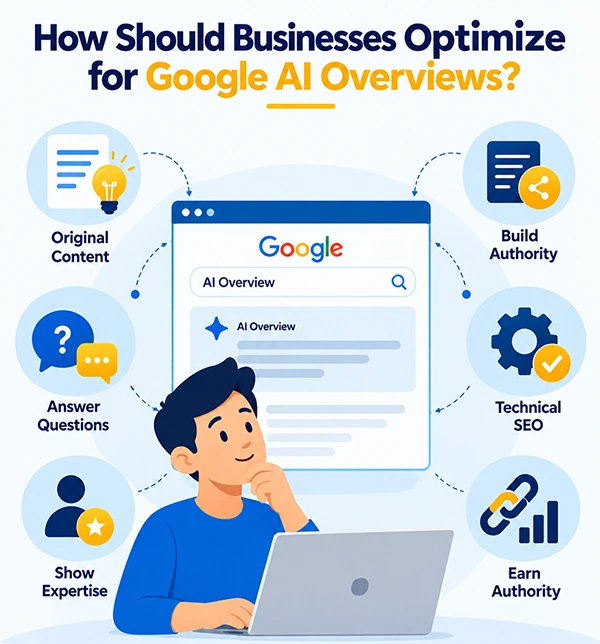
Companies should not view and approach Google AI Overviews as a completely different search engine that necessitates new SEO methods. According to Google, it’s clear that businesses can leverage the basic principles of SEO in the same way they always have.
Thus, the best way to optimize the website is to make it technically operational and offer unique, helpful content that fulfills the needs of the customers.
Create Original, Non-Commodity Content
Given the ability of AI systems to summarize existing information available on a plethora of websites, businesses should strive to provide something valuable, including original research, expert assessments, personal stories, case studies, proprietary statistics, clear examples, and useful recommendations. The ultimate aim here is to create content that Google would happily cite.
Answer Real Customer Questions
Develop content that answers the real questions of customers that they ask before making their buying decisions instead of focusing only on high-volume keywords. Address different types of queries in a thorough manner.
Demonstrate Genuine Expertise
Make sure the knowledge comes from experts, which means one has to include expert opinions, author credentials where appropriate, examples, evidence, case studies, and personal observations. It is better to show the expertise of the company rather than boast about it.
Build Topical Authority
Building topical authority entails addressing a concern in multiple formats, including guides, service pages, FAQs, reports, comparisons, case studies, and resources. It is also necessary to link them appropriately internally.
Maintain Strong Technical SEO
Using AI to search for things does not mean that one does not need crawlability, indexability, speed, accessibility, correct canonization, and links anymore. It is necessary for Google to be able to find the important content and understand it properly.
Build Legitimate Authority
Relevant backlinks, digital PR, mentions in the industry, expert contributions, and other references may support a website’s broader authority and reputation. However, Google has not confirmed that these factors directly determine inclusion in AI Overviews. The company has to focus on information creation rather than link management.
Should Businesses Change Their SEO Strategy in 2026?
Companies need to upgrade their SEO strategy in 2026 instead of entirely redoing it. AI mode and AI overviews are changing the information-seeking process for users since the core elements of SEO requirements are still significant.
- Revise content instead: Conduct an audit of your web pages for outdated, repetitive, thin, or incomplete information. Let’s upgrade them with relevant information, references to experts, real examples, and appropriate internal linking instead of creating even more content.
- Focus on search journeys instead of keywords: Try to understand what questions are addressed by clients while they are looking for the required product or service. Create materials that cover informational, comparison-based, commercial, and problem-solving searches.
- Expand your topic coverage: Create interconnected guides, services, FAQs, comparisons, case studies, and other materials that fit into your business topic.
- Show that you are an expert: Use your own experience, research, case studies, expert opinion, and proven information in order to create unique content instead of usual AI-made summaries.
The goal is not to abandon traditional SEO for “AI SEO.” It is to build a stronger, more comprehensive SEO strategy that performs across conventional search results and AI-powered search experiences.
How Businesses Can Measure Visibility in AI Search
Companies should track multiple metrics simultaneously. Like:
Organic Search Performance
Tracking needs to continue:
- impressions
- Clicks
- CTR
- search queries
- landing pages
- rankings
- Branded search vs. regular search
Google includes AI Overview traffic within the overall Web performance data in Search Console. However, Search Console does not provide dedicated AI Overview or AI Mode filters, so businesses cannot isolate all AI-feature performance through a dedicated report.
AI Visibility
When possible, check:
- if your brand is used
- if your website is mentioned
- what pages are cited
- what competitors are present
- what queries provide visibility
- if your company is included in informational inquiries vs commercial ones
Do not rely on a single AI answer as final data about your ranking. Results generated by AI can differ depending on query paraphrasing, context, region, recency and many other factors.
Business Outcomes
At the end of the day, the most important results are business ones:
- qualified traffic
- number of inquiries
- number of leads
- number of sales
- number of bookings
- number of revenues
- number of assists in conversions
- growth of branded search.
What This Means for Businesses Looking to Improve AI Search Visibility
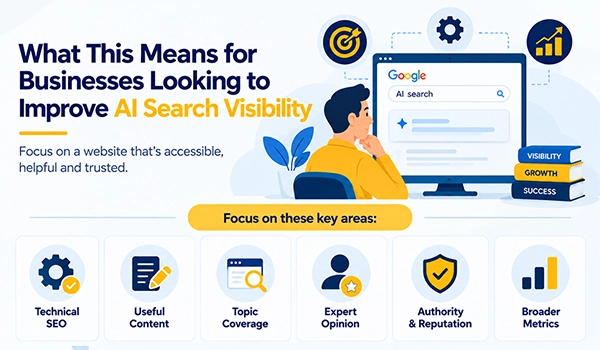
Improving visibility on AI search does not call for companies to move away from traditional SEO methods or strategies. Google has indicated that the basic principles of SEO are still crucial for AI Overviews and AI Mode. Instead, aiming to develop a website that will be accessible for search systems is more crucial than anything else.
Businesses should concentrate on the following key aspects:
- Proper technical SEO: Make sure that the most significant pages can be crawled, indexed, loaded quickly, and accessed from various devices.
- Useful content: The information should go beyond general information by also providing expert opinion, first-hand experience, research findings, and real-life stories.
- Comprehensive topic coverage: Provide answers for questions asked by customers during their research rather than just providing isolated keywords.
- Expert opinion: Back your claims up with the help of reliable evidence, including authorship, cases, and real-life experiences when applicable.
- Authority and reputation: Work toward earning credible backlinks and industry mentions as part of a broader authority-building strategy, rather than treating them as confirmed direct ranking factors for AI overviews.
- Broader metrics: Evaluate organic results alongside available evidence of AI mentions, citations, and referrals, while recognizing that Search Console does not provide dedicated AI Overview or AI Mode filters.
FAQ’s
Does traditional SEO still matter for AI Overviews?
Yes. Google confirms that established SEO fundamentals remain relevant for AI Overviews. Crawlability, indexability, relevance, helpful content, technical quality, and website authority still contribute to overall search visibility and provide the foundation for appearing in Google’s AI-powered search experience.
How can I optimize my website for Google AI Overviews?
Create original, helpful content that answers customer questions comprehensively. Maintain strong technical SEO, demonstrate genuine expertise, build topical authority, use internal links, and earn credible external references. There is no separate set of AI-specific requirements that Google says businesses must follow.
Is AI SEO different from traditional SEO?
AI SEO is commonly used to refer to optimizing visibility in AI-powered search experiences, but Google says no special optimization is required for AI features. It can involve conversational queries, comprehensive answers, source visibility, topical context, and brand authority while retaining core SEO principles.
Do backlinks still matter for AI search?
Relevant, authoritative backlinks remain valuable because they can strengthen a website’s credibility and authority. However, businesses should prioritize earning genuine references rather than purchasing manipulative links solely for AI visibility.
Does structured data help with AI Overviews?
Structured data can help Google understand page content and support eligible search features, but it does not guarantee AI Overview inclusion. Markup should accurately represent visible content and follow Google’s guidelines.
How can businesses measure AI search visibility?
Track available evidence of AI citations and mentions alongside organic impressions, clicks, rankings, branded searches, referral traffic, leads, conversions, and revenue. Keep in mind that Google Search Console includes AI-related traffic within broader Web performance data rather than providing dedicated AI Overview or AI Mode filters. This provides a more complete picture than traditional rankings alone.