

- What Are Google goto URLs?
- Why Is Google Using google.com/goto?
- How Does the Google goto Redirect Work?
- When Did Google Start Using goto URLs?
- Does Google goto Affect SEO Rankings?
- How Google goto Could Affect SEO Tools and Rank Tracking
- Does google.com/goto Affect Google Analytics and Referrer Data?
- What Does goto Mean for GEO and AI Search?
- Does goto Affect Website Owners?
- How to Check if Google goto URLs Are Appearing
- What Should SEOs and Website Owners Do Now?
- Frequently Asked Questions
- Conclusion
If you happen to be checking Google Search and see a link starting with google.com/goto, you will wonder what it signifies. Google has begun including a middleman redirect between certain Search results and the site being linked. Rather than going from Google Search -> Website, the click will now go through Google Search -> google.com/goto -> Website.
The change is practically invisible for the average user. However, for SEO specialists, it means new questions regarding ranking, analytics, crawling, rank monitoring, and automatic collection of Search data. SEO tools and SERP suppliers will need to take into account one more redirection to identify the real ranking domain, while webmasters will be pondering if they have to introduce changes into their redirecting, canonical, or tracking setup.
In this article, we’ll be explaining what Google goto URLs are, why Google came up with this idea, how they function, and what it means for SEO and GEO.
What Are Google goto URLs?
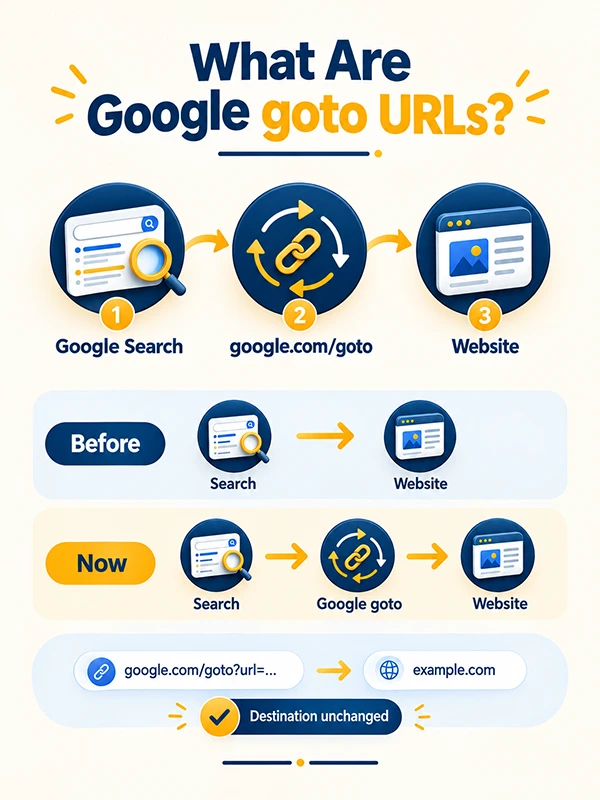
The Google goto URL is an intermediary Google Uniform Resource Locator (URL), which may appear after a search result instead of the respective website’s URL.
Previously, the process was such that:
Google Search → Website
Currently, with the new routing mechanism, the process is as follows:
Google Search → google.com/goto → Website
Thus, a link looks as follows:
https://www.google.com/goto?url=[encoded-or-opaque-value]
The value after url= does not have to be a readable URL. Tests done by experts in the industry show that its value works as an opaque identifier unique to Google, yet requires decoding by Google’s database.
For instance, the result that used to link to the following website:
https://example.com/best-running-shoes
will now include a link similar to:
https://www.google.com/goto?url=[encoded-value]
After clicking on the link, Google processes the intermediary URL and sends the user to the website:
https://example.com/best-running-shoes
The main point is that the website URL has not changed.
Instead, Google is changing the route used to get from the Search result to that existing destination. Get Me Rank similarly describes the change as an additional routing layer rather than a change to the destination website.
This is why the distinction between ranking and click routing matters. Google can continue ranking a page at position one while changing the technical URL used when someone clicks that result.
Why Is Google Using google.com/goto?
Two types of evidence exist in this context: one class that Google has confirmed as regards the changes, and one class that the search industry claims reflects the purpose of these changes.”
What Google has confirmed
Google has provided an intentionally very general response, as noted in the following statement by a representative of Google:
“We have a long history of deploying technical measures against evolving forms of abuse, and we regularly take steps to protect our services and users.”
Google has not provided detailed technical information identifying in detail the activities that fall under the goto system.
What the SEO industry believes
The design and timing have led several SEO companies to conclude that this is an anti-abuse measure that will complicate the extraction of Google Search results on a large scale.
The systems that might be affected by this design include:
- SERP scraping tools
- SERP ranking checking tools
- SERP APIs
- Google search automation tools
- Tools for monitoring competitors
- Search analytics platforms
- AI tools that collect Google Search results
- Internal SEO programs that process Google Search results data
In the past, a program that could read the HTML of Google’s Search results would usually quickly resolve the final URL. With this new update, resolving the final destination might require additional requests. This makes collecting Search data more expensive.
According to Nozzle’s reports, as of August 2026, the rollout was already close to being 100% completed among some residential IP providers. Industry reports also suggest that it might take hundreds of additional requests to resolve all the links in five Search result pages.
Nonetheless, even with all of these observations, it is inappropriate to conclude that Google created goto in order to fool SEO systems or AI programs. According to Google, this update is simply an attempt to curb the possible abuse.
How Does the Google goto Redirect Work?
The easiest way to understand the system is to consider google.com/goto as a routing layer. In the past, a search result could show the destination directly:
Search result → https://example.com/page
Now, the search result can show:
Search result → https://google.com/goto?url=[opaque value]
By clicking on the link, the Google server will receive a request and process the value before sending a redirect to the actual destination.
Testing has shown that a redirect has been observed as an HTTP 302 response, with the actual destination sent back to the user in the Location header. Google has not yet disclosed the exact implementation details of this system.
For an ordinary user, all of this may look quick and seamless. However, for an automated system that processes thousands or millions of results, this creates a fairly large difference.
Let’s say you have an SEO tool that checks for 10,000 keywords. It used to be that you could get a SERP, look through the links, and see where they come from. If they’re now hidden behind these complicated goto codes, it means more work to get the information you want.
Thus, you would have to:
Get an SERP → Find the goto codes → Find the redirects → Find the destination links → Calculate the rankings
Whereas you could have just had:
Get an SERP → Read the destination links → Calculate the rankings
According to some sources, the volume of requests needed for a simple 5-page ranking check may go up to anything between 500 and 1000 requests in bulk. The figures here are based solely on Measured Records by Nozzle, and so should not be assumed to be given by Google.
The bottom line is that the new system will make automated Search-result gathering more costly, slow, and difficult to scale.
When Did Google Start Using goto URLs?
The launch process was not a sudden action. The first sightings were witnessed in the months of June and July in 2026. While Alex Greenland saw the pattern on the 23rd of June, Brodie Clark did the same with more details in early July. In addition, the website Search Engine Roundtable reported on Google’s conduct of some tests concerning google.com/goto on July 8th.
The fact became more apparent during August. On the 26th of August, there were some reports from Nozzle that the system had achieved almost full coverage among different home IP providers.
The timeline can be provided in a shortened way
- June 2026: First public sighting takes place.
- July 2026: More professionals and data providers in SEO notice this behavior.
- Early August 2026: The pattern has become wider.
- August 26, 2026: Google gives confirmation of its actions.
- Late August- September 2026: More SEO and data providers have started adjusting to the new situation.
The essential thing to note is that the behavior is not the same among all users. Different cases show examples of how the presence of goto links can differ among users. For instance, DemandSphere noted its observation of the new links but at the same time pointed out that different users see different behavior.
In other words, the absence of a google.com/goto link in one of the browsers does not mean that the rollout is inactive.
Does Google goto Affect SEO Rankings?
This is one of the most significant questions regarding the change. Currently available information does not suggest that google.com/goto is a ranking factor, ranking penalty, or an update to the Google algorithm. The major difference is between ranking a page and directing a click after the page is ranked.
In theory, the process is:
- Ranking → Search Result → Click → Redirect → Website
The change with goto relates only to the last part of this process. Google’s ranking systems are responsible for what pages show up on Search and their position. The change regarding goto is about how a user or an automated system is redirected after the Search result appears. There is no evidence so far that leading users to a page through google.com/goto has any effect on its ranking.
Is goto a ranking factor?
There is no evidence as of now that it is.
Is it a Google algorithm update?
No. Google has confirmed that google.com/goto is a technical measure designed to protect Search against evolving forms of abuse, rather than announcing it as a change to its ranking systems.
Can goto trigger a ranking drop?
There is no evidence that the redirect takes place.
If a keyword is suddenly missing in the third-party rank tracker, it could be a data collection issue instead of a real ranking loss.
Will it affect indexing?
According to the current evidence, there is no indication that the goto wrapper affects the indexing of the landing page.
Will it affect crawling?
There is currently no indication that webmasters are required to change their crawling settings due to the Search Results redirect.
Do webmasters need to set canonical tags or adjust URLs or redirects?
The answer is no; webmasters will continue to use their regular canonical tags, internal links, XML sitemaps, URLs, and 301/302 redirects.
How Google goto Could Affect SEO Tools and Rank Tracking
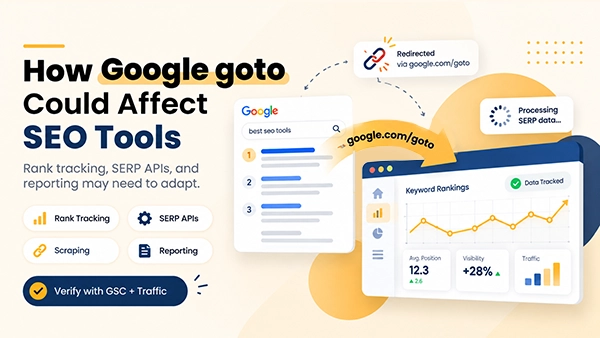
SEO tools may be one of the groups affected by the change the most. A rank tracker is usually required to get Google’s Search results many times for many keywords, regions, and devices, and analyze results for ranking positions and their URLs.
If the actual URL is no longer visible in the result markup, it is necessary to find an alternative way to identify it.
It may impact the following:
- rank-tracking systems
- SERP APIs
- SERP scraping
- competitor analysis
- automated keyword tracking
- SEO reporting systems
- search visibility systems
- internal enterprise SEO systems
A new redirect can lead to more requests being processed, more processes, and a bigger need for infrastructure. It can also mean a certain number of temporary errors in reporting while providers modify their systems.
For example, a rank tracker may discover that a specific page is at position five but be unable to link a new URL with an actual landing page at first. This situation could lead one to incorrectly deduce that a keyword has altogether vanished, or that a different URL is doing well in the rankings.
Thus, SEO teams must avoid interpreting sudden third-party ranking changes independently of all the other factors associated with them. When a tool reports a severe ranking drop, make sure to verify it against the following sources:
- Google Search Console.
- A manual search on Google.
- Organic traffic.
- Landing-page traffic.
- Conversions.
- Other independent SEO tools.
Leading SEO platforms have adapted their systems to handle the new google.com/goto redirects, showing that the change primarily affects how search data is collected and processed rather than how websites are ranked.
Does google.com/goto Affect Google Analytics and Referrer Data?
Analytics is another area that has raised concerns among SEOs
The fear is simple enough to grasp: if a user goes from a Google Search to google.com/goto before landing at a site, could GA read this visit as traffic from Google or even as Direct traffic? At this point, it will be too early to state that all Google’s organic traffic has switched to Direct.
Redirects do not immediately eliminate attribution. The referrer information might depend on the browser, on redirect mechanisms, and on other aspects of analytical implementation; hence the current industry suggestion is to observe the metrics instead of thinking that attribution has actually changed.
Moreover, one must understand how Google Search Console clicks differ from GA4 organic sessions.
Search Console provides information on how users interact with your site from Google’s perspective. GA4 collects information on website sessions, which can be attributed according to its own systems. The two systems do not have to be consistent in their indicators anyway.
For that reason, compare:
- GSC clicks
- GA4 organic sessions
- Direct traffic
- Organic landing pages
- Organic conversions
- Revenue or leads
- Third-party ranking data
If GSC clicks remain stable but GA4 suddenly reports a large increase in Direct traffic and a corresponding fall in Organic traffic, investigate the attribution path before concluding that Google rankings or demand have fallen.
The safest approach is to monitor first, change later.
What Does goto Mean for GEO and AI Search?
The introduction of goto could affect GEO-related tools, or Generative Engine Optimization, because AI systems are now being brought into the connection between the search results and web data.
Google has confirmed that the google.com/goto redirect is part of its technical measures against “evolving forms of abuse” and is intended to protect its services and users. The change may also make automated access to Google Search data more difficult for third-party tools, scrapers, and AI-powered search systems.
From a technical aspect, the reason makes sense. An automated system that may have been used to gather Search results before now has to collect:
Search position + title + destination URL
With the use of goto, it should collect instead:
Search position + title + Google redirect URL, and then deal with resolving the redirect before reaching the destination.
The additional step can influence how GEO tools work, how AI-related systems collect Search data, and how the agencies track visibility.
However, it should not be considered a confirmed goal of Google. Google has said that goto is part of its technical measures against evolving forms of abuse. It has not specifically confirmed that the purpose is to restrict AI search, GEO platforms, or AI crawlers.
The broader lesson for GEO professionals is that third-party Search visibility data may become increasingly dependent on the technical methods used to collect it.
Does goto Affect Website Owners?
For the majority of website owners, there is nothing exceptional to be done. The google.com/goto redirect is part of Google’s Search engine system and is not similar to a redirect set up by the owner of a particular website.
The current existing results of the website, i.e.
- 301 redirects
- 302 redirects
- Canonical tags
- Internal links
- XML sitemap
- URL structure
- Robots.txt
- Google Search Console settings
These do not need to be changed because of google.com/goto. Given that Google has chosen to line up search queries via google.com over the organic search result /goto.
For example, if the website has already utilized a redirect like:
example.com/old-page → example.com/new-page
One should continue to use this redirect according to the google.com/goto principle.
The same can be said about avoiding the creation of a special redirect for the reception of the Google goto traffic. Google’s gsearch-results redirect and the HTTP redirects on the website are functioning at completely different points. The practical approach is to go on with the implementation of ordinary technical issues of SEO and observe the statistics of performance.
How to Check if Google goto URLs Are Appearing
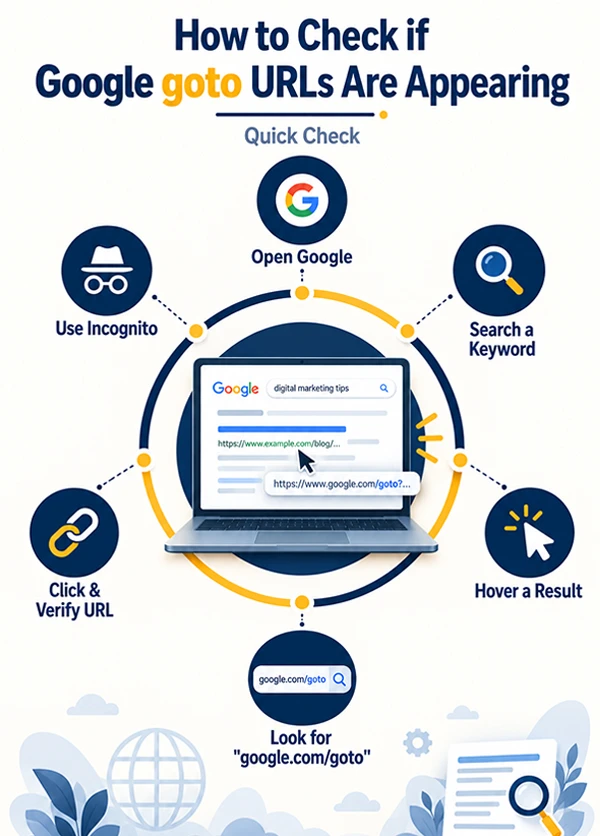
You can check the presence of the goto mechanism in your current search results.
Perform the next steps:
- Launch Google Search
- Open an incognito or private browser
- Type an ordinary keyword.
- Hover over the organic search result.
- Cross-validate the destination or URL appearing in the browser.
- See whether the URL contains google.com/goto.
- Click the organic result.
- Ensure you get your expected destination URL.
The reason for the use of an incognito window is the information that it indicates different behavior between logged-in and logged-out Search environments.
If one does not see google.com/goto, it does not mean that the rollout is absent, as Google’s implementation is browser-, account-, IP-, and Search experience-specific. The purpose of this test is to check what your current Search state is returning.
What Should SEOs and Website Owners Do Now?
The most logical measure to take is to keep a close watch instead of making unwanted technical modifications.
Checklist for website owners:
- Do not change website URLs because of goto.
- Do not set up special redirects for Google goto URLs.
- Keep existing 301 and 302 redirects.
- Keep existing canonical tags.
- Continue normal technical SEO.
- Monitor Google Search Console.
- Be vigilant with GA4 organic traffic and Direct traffic.
- Compare first-party data with third-party ranking reports.
- Check rank-tracking tools for unusual reporting behavior.
- Be vigilant with organic traffic, landing pages, and conversions.
- Wait for further technical clarification from Google before making major changes.
For SEO teams in particular, the crucial change could be in how information from third parties is interpreted. If a rank tracker shows a significant dip shortly after the rollout, do not jump to conclusions saying that the rankings were changed by Google all of a sudden. Make sure that the tracker sees Google’s new redirect structure correctly.
If GA4 is saying that there is a change in attribution, already compare it with Search Console data and actual business performance, and only after that brainstorm changes in your measurement system.
Frequently Asked Questions
What is a Google goto URL?
A Google goto URL is an intermediary Google link that routes users through google.com/goto before redirecting them to the final destination website.
Why is Google using google.com/goto?
Google says goto URLs are part of technical measures designed to address evolving abuse and protect Google Search services and users.
Is Google goto a ranking update?
No. Google goto is a Search-result routing change, not a confirmed ranking algorithm update or ranking factor affecting website positions.
Does goto affect SEO?
Goto may affect SEO tools and search data collection, but there is currently no evidence that it directly changes rankings, indexing, or crawling.
Does goto affect Google Search Console?
There is currently no evidence that goto changes Search Console reporting. Website owners should continue monitoring clicks, impressions, rankings, and other performance metrics normally.
Does goto affect GA4?
No, Google’s google.com/goto redirects do not currently appear to affect GA4 attribution. However, redirects can potentially affect referral information in some circumstances, so it is worth monitoring GA4 organic and direct traffic for unexpected changes.
Will goto affect rank-tracking tools?
Potentially. Rank trackers may need additional requests to resolve goto redirects, increasing processing requirements and potentially causing temporary reporting inconsistencies during adaptation.
Does goto block SERP scraping?
Not necessarily. Goto can make automated scraping more difficult by hiding destination URLs and requiring additional requests to resolve Search-result links.
Does goto affect GEO?
Potentially. AI and GEO tools collecting Google Search data may need additional processing to identify destinations, although Google’s specific AI-related intent remains unconfirmed.
Do website owners need to change anything?
No. Website owners generally don’t need to change URLs, redirects, canonicals, sitemaps, robots.txt, or other technical SEO configurations because of Google goto.
Conclusion
The “google.com/goto” URLs signify a change in the manner Google routes its users rather than the websites listed in a particular search. Google used to send users straight from a search result to the landing page, but with the advent of the “goto” process, Google can now send users via the URL “google.com/goto” before reaching the destination page.
For SEO specialists, the most significant piece of information here is that the “goto” URLs should not be seen as a ranking algorithm or ranking factor of some kind. There is no indication that the redirection process impacts the ranking, indexing, or other technical SEO aspects of any website.
The major impact may arise from developments in the tools and systems that gather Google Search information. SERP scrapers, ranking trackers, and SEO tools may require extra procedures to handle destination URLs.
Thus, website administrators do not need to make any changes to their URLs, canonical links, or redirects in order to cope with “goto”. The right way to do this now is to check “GSC”, “GA4”, the rankings, volume of traffic and conversions, and look carefully into peculiarities before taking further steps in technical SEO.