

Online search is changing! According to DataReportal, more than 1 billion people worldwide are now actively using AI platforms each month, highlighting the growing importance of GEO for AI-system discovery. However, the question stands: “What is GEO?” Well, GEO (Generative Engine Optimization) is a process that helps to format and craft well-structured content so that it can be easily understood, retrieved, and cited or mentioned by AI-generated responses.
For businesses in Delhi and India, this shift is a fortunate visibility opportunity. Your website’s visibility will not be limited to SERP ranking, but will also appear on AI-powered platforms as a credible, trustworthy source, boosting brand awareness and authenticity. However, GEO is not just a writing discipline; it’s a fundamental optimization methodology, somewhat like SEO.
Therefore, in this blog post, we have generative engine optimization explained to help you understand how it works and why it matters so much now.
What is GEO?
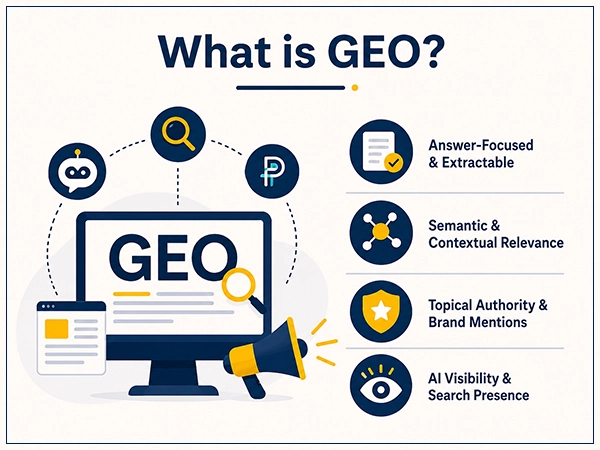
Generative Engine Optimization (GEO) is the practice of optimizing content so it can be easily cited, quoted, or recommended by AI systems like ChatGPT, Google AI Overviews, and Perplexity, rather than ranking in traditional search results. While traditional SEO methodology is more focused on keywords, links, and SERP rankings, GEO gives more importance to:
- Content Extractability & Answer Optimization
- Semantic & Contextual Relevance
- Topical Authority & Brand Mentions
- AI Visibility & Search Presence
For example, when a user asks an AI search engine, “What is the best digital marketing agency in Delhi NCR?”, GEO will try to cite your brand, website, or related content among the sources used to formulate the AI-generated answer. In short, we can say GEO is best viewed as an extension of modern SEO rather than a replacement for it.
GEO Overlaps AEO, AIO, and LLM Optimization
GEO focuses specifically on increasing your content visibility within generative and AI-powered search experiences; simultaneously, it overlaps with further related disciplines, such as:
- Answer Engine Optimization (AEO): The process of formatting content with direct answers to user queries.
- AI Optimization (AI): Broadly focuses on improving content or digital assets for AI chatbots, like ChatGPT, Gemini, and Google AI Overview.
- LLM optimization: Implemented to make information/content easier for Large Language Models to understand and retrieve.
GEO vs SEO: What’s the Difference
Although GEO and SEO are closely connected, they both primarily concentrate on different search experiences. Here, we have mentioned a simple comparison table (GEO vs SEO) below, featuring their core differences; take a look.
| S No. | Factors | Generative Engine Optimization (GEO) | Search Engine Optimization (SEO) |
| 1. | Primary Goal | Visibility in answers generated via AI chatbots. | Organic search and ranking on SERP. |
| 2. | Targeted Platform | AI-powered search engines, such as ChatGPT, Gemini, Google AI Overview, Perplexity, Claude, and others. | Search engines, like Google, Bing, DuckDuckGo, Microsoft, and others. |
| 3. | Content Focus | Direct answers, factual context, authority, and useful information. | Technical SEO, keywords, search intent, and hyperlinks. |
| 4. | Optimization Approach | Format structured content so AI systems can understand, retrieve, and use it in their generative answers. | Improve content for users and search engines. |
| 5. | Visibility Signal | AI visibility and source inclusion. | Organic traffic, ranking, visibility, and clicks. |
| 6. | Success Measures | AI mentions, citations, and visibility. | Higher SERP ranking, organic traffic, conversions, and CTR. |
The important thing to remember is that GEO does not replace SEO. In fact, Google documentation cited the SEO practices not only work to get your site ranked on the first page of Google, but also apply to AI features like AI Mode and AI Overviews.
AEO vs GEO
Often, users get confused between Answer Engine Optimization (AEO) and GEO, as they both work for AI systems and overlap. However, they have different focuses. Below, we have presented a simple comparison table; take a look.
| Factors | GEO | AEO |
| Primary Goal | Improve the website’s content visibility in AI-generated responses. | Deliver direct answers to users’ queries. |
| Content Depth | Comprehensive, contextual, and authoritative. | Answer-focused, concise content. |
| Technical Focus | Content accessibility, well-structured, entities, and crawlability. | Answer-friendly formatting, structured data (including lists & tables), and FAQs. |
| Sucess Metrics | AI citations, mentions, visibility, and brand presence. | Featured in snippets and voice query placement. |
| Targeted Surface | LLM chat engines, AI Overviews, and conversational tools. | Knowledge panel, featured snippets, and voice assistants. |
Why Does GEO Matter Now?
Nowadays, AI search has significantly shifted from keyword-matching to conversational, high-intent synthesis. Leveraging natural language processing, search engines collect and convert data into direct answers to user queries, instead of giving a list of blue links first.
This not only lowers standard click-through rates but also changes user behaviour and how information is found online, prominently increasing the implementation of generative engine optimization (GEO).
Rather than browsing and scrolling SERP links, users now look for their answers on the AI-geenrative summaries or responses on platforms like ChatGPT, Gemini, Claude, and Google AI Overviews.
Here is exactly where generative engine optimization’s role comes in! It ensures your brand, website, or related content is cited, mentioned, and recommended within these platforms’ responses, instead of getting lost in zero-click searches. Thus, recent reports and stats show that marketers believe a strong search strategy should focus on both traditional rankings and AI-driven discovery.
A Quick GEO Optimization Checklist
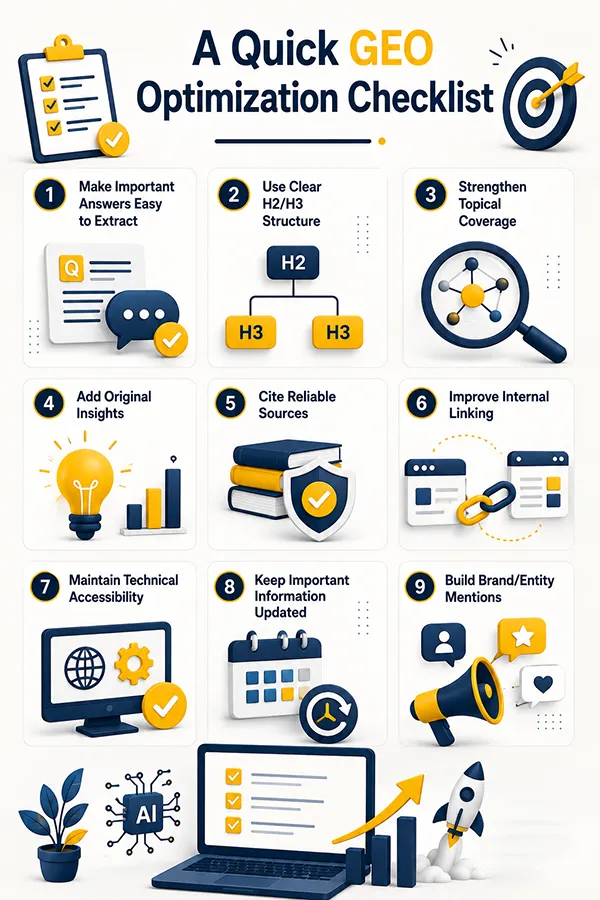
Understanding “what is GEO” is only a first step. To make your content more accessible to AI-powered search engines, apply these practical optimization steps:
- Make Important Answers Easy to Extract: Try to provide clear, direct answers to key questions.
- Use Clear H2/H3 Structure: Organize your content with logical and descriptive sections.
- Strengthen Topical Coverage: Ensure you have covered related questions, entities, and relevant subtopics.
- Add Original Insights: Include unique data, examples, research works, and expert studies.
- Cite Reliable Sources: Support your important factual claims with credible and authentic references.
- Improve Internal Linking: Link relevant internal pages to strengthen topical relationships across your website.
- Maintain Technical Accessibility: Ensure important content is indexable, crawable, and easily accessible to search engines.
- Keep Important Information Updated: Regularly update included statistics, facts, examples, and recommendations.
- Build Brand/Entity Mentions: Strengthen your brand’s presence through consistent mentions across relevant, authoritative sources.
How Do AI Engines Choose What to Cite?
Evidently, AI search engines do not cite every piece of content they encounter. AI search systems do not simply rely on keyword-stuffed content; the machinery looks for relevant, useful information to answer their users’ queries. Therefore, if you also want to know how to get cited in Google AI Overviews, go through the sections below carefully to comprehend the important factors.
1. Clear and Structured Content
Instead of burying answers in long paragraphs, state direct, clear statements. For this, try to use:
- Straightforward headings (H2s and H3s).
- Short Paragraphs
- Bullet Points
- Tables & Lists
- Step-by-Step Explanations
- Question-Answer Format
For example, if your page clearly talks about “how to optimize content for generative AI”, an AI system has an easier time identifying, retrieving, and citing your content in its generative responses.
2. Direct Answers to Users’ Queries
Unlike SEO, where we build content only targeting the focused keywords, GEO ensures your page covers all around the real search intent. For instance, instead of building a heading about “GEO,” address high-intent questions like:
- What is GEO in SEO?
- How does GEO work?
- How to appear in ChatGPT search results?
- How to optimize content for generative AI?
Therefore, by doing this, the AI system will clearly get the topical context of your page, increasing the chances of being cited.
3. Structured Data and Technical SEO
Notably, Google has stated that there is no such special schema or AI-only markup required to get visible on AI-generative responses. Hence, this clearly highlights, technical foundation still matters.
Accordingly, web pages still need to be indexed and must comply with traditional search visibility to be eligible as supportive links in Google AI overviews or any other AI engine result. Also, do not overlook technical SEO fundamentals, such as crawlability, textual content, internal linking, and structured data that matches the real search intent.
4. E-E-A-T
E-E-A-T stands for Experience, Expertise, Authoritativeness, and Trustworthiness, a conceptual framework used in Google’s Search Quality Rater Guidelines to assess the quality and credibility of online content. To adhere to this foundation, try to add the following things to your writing.
- Original Insights
- Expert Authorship
- Transparent Information
- First-Hand Experience
- Reliable References
5. Credible Sources
Do not forget to support your important claims or statistics with relevant, authentic evidence. Try to link crucial information with:
- Recognized Organizations
- Government Sources
- authoritative research
- Reputable Industry Publications
- Original Case Studies
This will build trust for your website among both users and AI systems.
How to Get Cited By AI Search Engines?
Evidently, there is no guaranteed formula for appearing in AI search results. However, you can increase your chances of getting cited by AI systems by:
- Follow an answer-first format by stating a short, direct answer to the user’s query right under your H2s and H3s.
- Instead of targeting a single focus keyword, build in-depth content that covers the real search intent.
- Rather than short or traditional keywords, use natural and conversational language with long-tail keywords.
- Strengthen your website’s technical SEO.
- Always support your factual claims with credible sources, such as Reddit, Wikipedia, and top industry sites.
- Regularly update your information that becomes outdated.
- Check your robots.txt to ensure OAI-SearchBot and other retrieval bots have complete access to easily index your website’s content.
Notably, for Google AI Overviews and AI Mode, there is no separate technical checklist that guarantees inclusion in AI-generated responses. According to Google, for GEO, you must follow the same core Search requirements and SEO practices.
What Are the Common Myths About GEO?
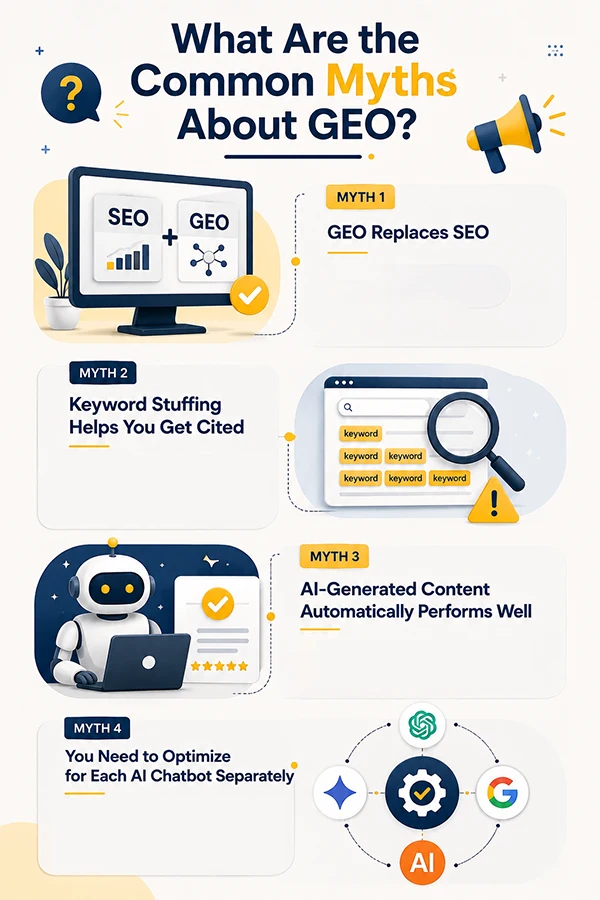
Since GEO was introduced, several myths have arisen, leading to misconceptions among all online users, including:
1. GEO Replaces SEO
GEO and SEO work together. Generative engine optimization techniques are just a useful extension of traditional search engine optimization practices, helping businesses improve both traditional ranking and citation on different AI systems.
2. Keyword Stuffing Helps You Get Cited
Repeating keywords in your content won’t improve your ranking or AI mention chances. Instead of this, craft content with relevant information, direct answers, factual accuracy, and strong topical coverage.
3. AI-Generated Content Automatically Performs Well on AI Platforms
Using AI does not guarantee visibility. Both the leading search engines and AI systems favor content featuring broad topical coverage, relevancy, authentic links, and direct answers. Producing large amounts of low-value AI-generated content can also violate Google’s spam policy.
4. You Need to Optimize Content For Each AI Chatbot Separately
There is no specific technical checklist given for any AI system. Also, platforms like ChatGPT, Gemini, Google AI Overview, or Claude may have differences, but their core optimization principles work the same across all.
Conclusion
In a nutshell! AI systems are changing what search visibility means. Understanding what is GEO no longer optional; it has become essential for businesses that want to stay visible on AI-powered platforms, like ChatGPT, Google AI Overview, Gemini, Claude, and others.
At Battersea Web Expert, we help businesses in Delhi and across India explore GEO services, LLM marketing, content optimization, and brand authority strategies to strengthen their search visibility on different AI-generated responses. Thus, explore Battersea Web Expert services today to begin building your next-generation search strategy today!
Frequently Asked Questions
What is GEO in SEO?
Generative Engine Optimization (GEO) is the latest extension to traditional SEO practices that helps to improve your content visibility with AI-generated answers. It helps AI systems understand, retrieve, and cite or mention your content when responding to user queries.
How to optimize content for generative AI?
To optimize your content for AI search visibility, craft content covering broad topical context, provide direct answers, demonstrate expertise, cite credible sources, add relevant structured data, include a table or list, and update it regularly. Also, strong technical SEO supports visibility across AI-powered search experiences.
How to appear in ChatGPT search results?
Evidently, there are no guaranteed methods for appearing in ChatGPT-generated answers. However, you can improve your visibility chances by building useful, authoritative, and crawlable web content that can be easily evaluated by AI systems.
Does GEO help in improving traditional Google rankings?
No, GEO does not directly guarantee higher Google rankings. However, many GEO practices, like creating helpful content, creating authentic links, covering a broad topical approach, and improving technical SEO, also support organic search performance.
How often should I update GEO content?
For increased visibility within AI systems, GEO content should be reviewed regularly, especially when you cover topics related to technology, industry trends, or contain factual claims.