

- What Is SynthID?
- How Does SynthID Work?
- How to Check Whether Content Contains a SynthID Watermark
- Which Companies Use SynthID?
- What SynthID Cannot Do: Important Limitations
- Does SynthID Affect SEO Rankings?
- Should Your Business Worry About AI Images on Its Website?
- A Safer Way to Use AI Content for SEO in 2026
- SynthID vs C2PA: What Is the Difference?
- Frequently Asked Questions About SynthID
- Conclusion: What SynthID Means for Your SEO Strategy
Google has made it easier for anyone to check if an image, video, or audio file was made with AI. Google DeepMind opened its SynthID Detector to the public on October 7, 2026, making it easier for users everywhere to check whether images, videos, or audio files contain hidden AI watermarks. This enables users everywhere to validate multimedia content for hidden AI watermarking.
This news was shared through an article written by Pushmeet Kohli, the VP of Science and Strategic Initiatives at Google DeepMind. The company claims that it has already watermarked over 180 billion images and videos and approximately 240,000 years of audio materials.
What does this mean for the businesses, website owners, and digital marketers?
SHORT ANSWER
SynthID is not a ranking signal, but rather a watermark verification tool. The public detector tells which media is marked with relevant machine-generated watermarks, but it does not say whether the content of the site is good enough to rank, nor does it mean that using AI for writing will get penalized.
What Is SynthID?
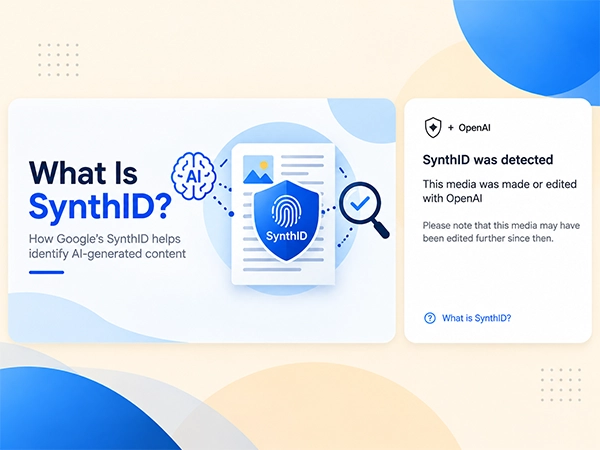
SynthID is a cutting-edge technology for digital watermarking created by Google DeepMind to ensure proper categorization of the content that has been produced by or altered using some supported AI systems.
Unlike an ordinary visible mark, symbol, or disclaimer, a SynthID watermark has been created in a way that it cannot be detected by a human but can be easily spotted by specific technology. Based on the media in question, watermarks are implanted into the original image, audio, video, or text generation.
The main aim is to create a mechanism for proving the fact that AI tools were used to generate certain content. For example, if a company uses an AI image creator for making an advertisement, it will create an ordinary picture that does not look like has been produced by artificial intelligence. In this case, if it was produced with the use of a SynthID watermark, it can be scanned and discovered.
Google launched SynthID in 2023 to mark AI-generated media; however, SynthID does not show that content is true or good
How Does SynthID Work?

The way SynthID operates varies according to the type of material being created.
When it comes to videos or pictures: This is when the watermark is integrated into the digital materials and stays detectable after common edits like cropping, filtering, or compression.
With regard to audio files: Here, we find out that the watermark is inserted into the audio stream so it cannot be audible but can be easily put through verification.
When it comes to written text: SynthID Text uses a different approach. It works with text generation by changing the distribution of probabilities of token options in such a way as to form a statistically identifiable pattern.
With such approaches, no obvious watermark is imposed on the content. This is why the verification process relies on appropriate verification tools.
Nevertheless, there is one crucial thing to clarify: the public SynthID Detector is able to check images, audio, and video. It should not be considered an AI-based universal text checker.
Google, however, made a separate note regarding SynthID Text and its scope and limits. The presence of watermarking does not mean that all AI-created articles come with a SynthID watermark.
How to Check Whether Content Contains a SynthID Watermark
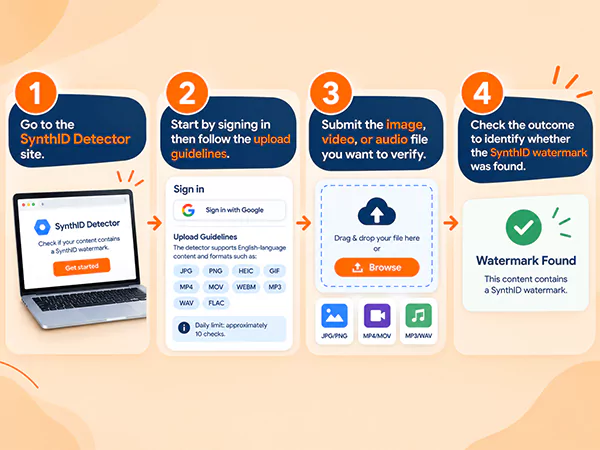
Google offers multiple options for determining if supported AI tools played a role in making digital content. The selection of the method is determined by the type of file as well as the verification tool.
1. Use the SynthID Detector
The public detector can be found at synthid.com.
Follow these steps:
- Go to the SynthID Detector site.
- Start by signing in then follow the upload guidelines. The detector supports English-language content and formats such as JPG, PNG, HEIC, GIF, MP4, MOV, WEBM, MP3, WAV, and FLAC, with a daily limit of approximately 10 checks.
- Submit the image, video, or audio file you want to verify.
- Check the outcome to identify whether the SynthID watermark was found.
If the file is a video or audio, observe all portions indicated with watermark data.
Google advises using the highest quality file for better detection results.
The detector supports AI solutions developed by Google and its partners such as OpenAI, NVIDIA, and Kakao. The website mentions that Apple will join soon, though one should make sure of its availability rather than assume it.
The service is available to the public, but the requirements for logging in and usage limits may change from time to time and should be checked on the website.
2. Check Media Through Gemini
You can also check files in the Gemini app to see whether a particular video or image was created or altered by Google AI technology.
Simply upload the corresponding media and ask whether it was made or altered thanks to Google AI. Gemini might check for the SynthID watermark, subject to the availability of the required technology. A result from Gemini is a useful check, not a guarantee.
3. Use Google Search and Chrome Verification Features
Google has included AI detection features in some aspects of its Search technology as well as in its Chrome browser.
Users have the ability to take advantage of the functions offered by Google Lens, AI Mode, or Circle to Search to view images and get more information about them depending on the accessibility and type of content that is being scrutinized.
For additional details, see Google DeepMind’s SynthID documentation.
Which Companies Use SynthID?
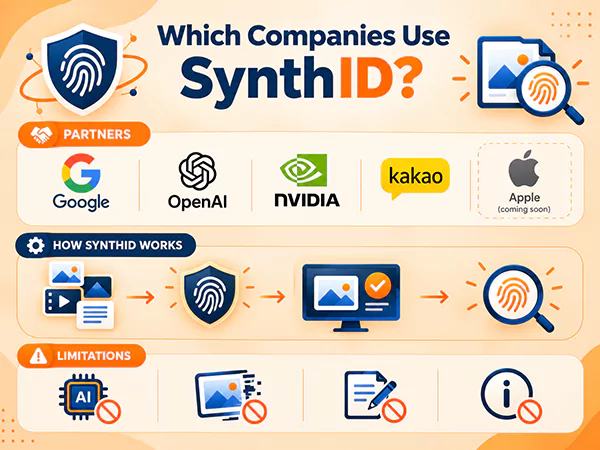
SynthID started as an initiative of Google DeepMind but later partnered with other artificial intelligence companies.
Google announced the expansion on October 7, 2026. It was specified that the public detector will function together with systems from Google, OpenAI, NVIDIA, and Kakao. It was mentioned that Apple support will follow in a while.
The newly introduced functionality makes the detector more valuable than a solution that can analyze only content that was created with Google’s tools. More partners mean the detector can confirm more files
In particular, the detector developed to identify specific watermarking systems does not guarantee the identification of created files that were produced using any artificial intelligence software. If an image is produced by an artificial intelligence model that does not implement the supported SynthID watermark, it will not be identified by the detector.
Moreover, if a watermark is heavily edited or damaged and the detector is unable to successfully identify it, the same issue will arise here as well. Therefore, SynthID should be treated not as a universal solution to verify AI-created content but rather as a tool in the wider spectrum of artificial intelligence content verification methods.
What SynthID Cannot Do: Important Limitations
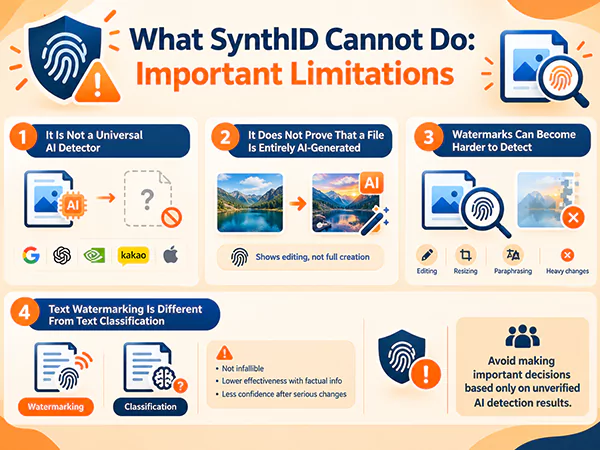
While SynthID is able to provide valuable information, it is important that its findings are interpreted accurately.
It Is Not a Universal AI Detector
The SynthID Detector searches for watermarks that are being used, but it cannot make the claim that a file has been created by AI technology on its own.
Even if a file was created using a model that SynthID does not support, the detector may not be able to identify its AI watermark.
A “No watermark found” result does not prove that a file was created by a human; it only means that the detector did not identify a SynthID watermark in the file.
It Does Not Prove That a File Is Entirely AI-Generated
An AI watermark may make it possible to identify media that has been modified or generated by a specific software.
For instance, one photographer may click the original image and then make use of AI software to edit the background of that image. By checking this watermark, it may be proven that AI was being used, while it does not show that an image was created using AI completely from scratch.
This difference is crucial for businesses using AI to edit photos. It helps separate images created or edited with AI methods used by a certain company.
Watermarks Can Become Harder to Detect
The system for SynthID is intended to be resistant to the most typical changes, but it cannot always be trusted. Major alterations might lead to lower efficiency of a watermark and hinder the identification process.
Regarding SynthID Text, the information provided by Google states that careful paraphrasing and a few modifications may still preserve essential evidence for watermarking, while heavy transformation may dramatically decrease confidence in the detection. Thus, A detection result is one signal, not foolproof.
Text Watermarking Is Different From Text Classification
A text-watermarking detection tool is seeking a statistical sign of watermarking, while the classification algorithm is trying to assess whether the content has been generated by artificial intelligence.
Both methods should not be viewed as infallible ways to determine authorship.
Even Google’s documentation recognizes that text watermarking is characterized by some limitations, including lower effectiveness in cases involving factual information and a lower degree of confidence in cases of serious transformation.
Overall, the lesson is clear for companies: avoid making decisions in the field of publication, employment, and editing based solely on the result of unverified AI detection.
Does SynthID Affect SEO Rankings?
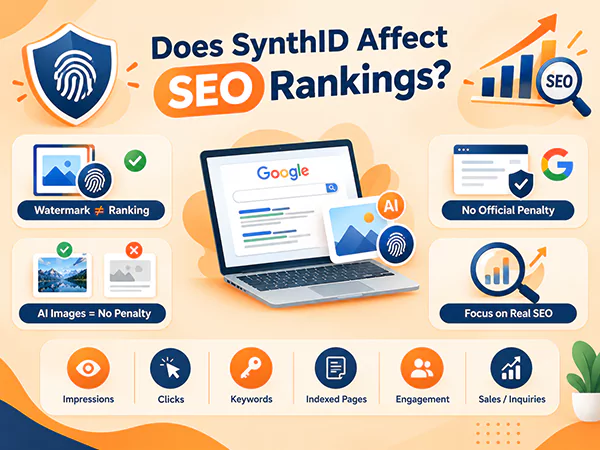
There is no official Google release that suggests SynthID detection is a part of Google’s search engine ranking system. The announcement made on October 7 is about the identification of AI-generated content and does not mention the implementation of any new type of ranking penalty for using AI.
This difference matters for SEO.
A watermark is different from a ranking system. The watermark is a feature of SynthID that aids the identification of AI-generated content. Ranking systems analyze numerous criteria to evaluate relevance, quality, usefulness, and compliance with Google’s policies.
Just because an image has a SynthID watermark doesn’t mean that it will rank poorly on a page.
Conversely, just because an image does not have a watermark doesn’t mean the image meets Google’s quality guidelines either.
Does Google Penalize AI-Generated Content?
According to Google’s official guidelines, the presence of AI does not necessarily indicate a breach of Google’s Search policy. In its guidance on AI-generated content, Google outlines a range of positive uses of AI, including the creation and arrangement of content, but warns that it becomes problematic when it is used purely for gaining search rankings through many pages with little value to users
Take two businesses, for example.
- Business 1 uses AI for research and the evaluation of information and creates a quality piece on its own.
- Business 2 performs widespread copying of generic service pages, changing a couple of keywords without verifying information about services rendered or anything else.
While both organizations use AI in their operations, how useful these pages will be is determined by the actual performance practices rather than the presence of AI during their creation process.
What About AI Images on Websites?
The same logic goes for images generated by artificial intelligence.
An image created with the help of AI doesn’t pose a problem for SEO just because it is watermarked.
What is important to consider when optimizing the website is whether the image matches the aim of the page, complements the content, loads quickly, and provides good user experience.
Other points to discuss are accuracy and honesty. A picture created by AI could be used to demonstrate an abstract idea, while a real picture could be useful for showing real offices and people, work done, etc.
Google imposes some requirements on product images created with the help of AI technology and their metadata.
What Should Businesses Monitor Instead?
Rather than considering SynthID as a way to gauge success, webmasters must focus on SEO performance.
It is essential to track organic impressions and clicks, relevant keyword reporting, indexed pages, engagement levels on significant landing pages, and inquiries or sales. It is important to analyze performance changes together with problems and issues of technical nature, content quality, search intent, and relevant updates from Google.
The same focus on useful content and proper technical SEO applies to websites participating in AI-powered search experiences. Google’s guidance on AI tools in Search clarifies that established search guidelines still apply to these experiences.
More assistance with this can be provided through our SEO services as well as GEO services, which are provided in Delhi.
Should Your Business Worry About AI Images on Its Website?

Business operators in the capital and other parts of the country are utilizing AI tools for generating promotional images in the form of marketing graphics, posts for social media, illustrations for blogs, and banners. The SynthID technology provides yet another tool to check the origin of supported AI-generated media, but its availability does not mean that all the images produced by means of AI should be taken away.
It is advisable to analyze the images depending on their functions and the expectations of the clients.
AI-generated images may suit the conceptual illustration of a blog. However, for a restaurant that needs to show its interior space, a real estate company that has to demonstrate a property, or an agency that advertises finished projects, it has to be real images to provide clear evidence of what can be expected.
Follow the rules for naming the files and put relevant alt text; make sure the size of the images is reasonable, compress the files if needed (a technical SEO audit checklist can help you check this); and do not mislead by means of images.
If the image in any case can have an impact on the customers’ purchasing decision, it must accurately depict the offered goods or services.
A Safer Way to Use AI Content for SEO in 2026
AI can improve the content-producing process, but merely being fast does not mean that the company will have a competitive advantage in search.
It is necessary for a company to develop a review system that turns AI-written drafts into meaningful content.
Start with simple automation tasks: organizing your research, finding common questions your clients ask, creating a basic outline, or enhancing readability. Then, let a professional writer or subject matter expert check the veracity of the information and improve its quality.
Add original information that competitors’ websites will find difficult to create. This may be your unique examples, tips, client questions, observations, or other information related to these domains.
When it is suitable, provide the names of the authors, quote credible sources when mentioning important facts, update the information when changes happen, and inform readers about the use of the technology if it is beneficial for them.
Do not create a large number of pages with the same information, only changing keywords, as this is a common reason why a website is not ranking on Google. Each page should answer a unique user question and provide enough value to make it worth existing for its audience.
These practices align with Google’s spam policies and its guidance on creating helpful, reliable, people-first content.
For businesses that need professional support, content writing services in Delhi can help develop content around customer needs, search intent, and business objectives.
SynthID vs C2PA: What Is the Difference?
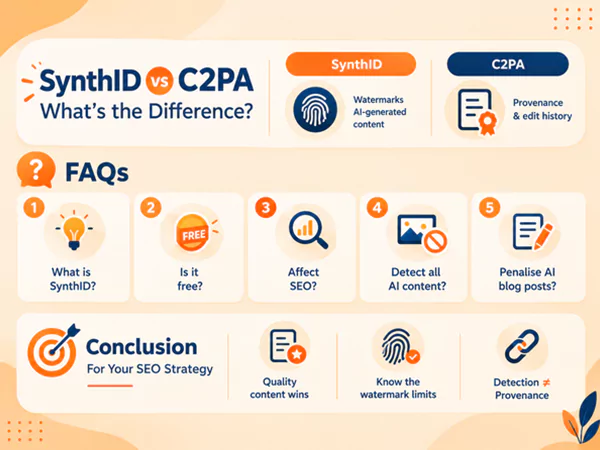
While both SynthID and C2PA focus on making AI-generated content more transparent, they take different approaches.
SynthID only marks content from supported tools as AI-generated material, allowing its detection per the instructions of tools that are designed to spot that watermark.
C2PA attaches signed Content Credentials that show where a file came from and how it was edited, and this metadata can also be removed.
For clarity, SynthID emphasizes watermarking, while C2PA focuses on building provenance.
Nevertheless, neither system is able to guarantee complete information about any given digital asset. Therefore, the methods will complement each other.
Frequently Asked Questions About SynthID
What Is SynthID in Simple Terms?
SynthID is an invisible digital watermarking technology developed by Google DeepMind. It helps specialized tools identify supported AI-generated or AI-edited images, videos, audio, and, through a separate implementation, text.
Is SynthID Detector Free to Use?
Yes, SynthID Detector is free to use. Google opened public access on October 7, 2026, through SynthID.com. Users must sign in, and usage is limited to approximately 10 checks per day. The portal is available in English, and supported file formats include PNG, JPEG, WebP, AVIF, TIFF, OGG, AAC, and M4A. Check the official website for the latest access requirements and limitations.
Does SynthID Affect Google Rankings?
Google has not announced SynthID as a ranking factor. A detected watermark is not, by itself, evidence that a webpage will be penalized. Website owners should focus on helpful content, search quality, and compliance with Google’s spam policies.
Can SynthID Detect All AI-Generated Content?
No. The public detector identifies supported SynthID watermarks in images, videos, and audio. It cannot reliably identify every AI-generated file, especially when the generating model does not use a supported watermark or the signal is no longer detectable.
Does Google Penalise AI-Written Blog Posts?
Not automatically. Google’s published guidance permits appropriate AI use. Content created primarily to manipulate search rankings, including unoriginal pages generated at scale without meaningful added value, may violate its spam policies.
Conclusion: What SynthID Means for Your SEO Strategy
Google’s SynthID is designed as part of the search engine giant’s wider initiative to enhance transparency in AI content. Essentially, authenticating AI-generated content differs from assessing content quality and efficacy from an SEO standpoint.
Key aspects of an effective strategy in SEO are:
- Content quality is key: Concentrate on providing unique insights, factual correctness, relevance, and providing real value instead of what type of content has been produced.
- Recognize watermarking capabilities: While SynthID does assist with identifying the watermark of AI-generated content, it is not capable of recognizing every format of AI-generated media and establishing the author of the content.
- Learn the difference between detection and provenance: The operation of SynthID revolves around invisible watermarks, while the C2PA system employs signed provenance data to keep a record of how an asset has been modified and where it originated from.