

- What Is Google’s September 2026 Spam Update?
- How Much Traffic Did Websites Lose After Google's September 2026 Spam Update?
- How to Recover from the Google September 2026 Spam Update: Step-by-Step
- Remove, Fix, or Keep? A Simple Recovery Checklist
- What NOT to Do After a Spam Update
- How Long Does It Take to Recover from a Spam Update?
- Can AI-Generated Content Cause a Google Spam Penalty?
- Spam Update vs Core Update
- Was There a Core Update in September 2026?
- Frequently Asked Questions
- Conclusion: Build a Sustainable Recovery Plan
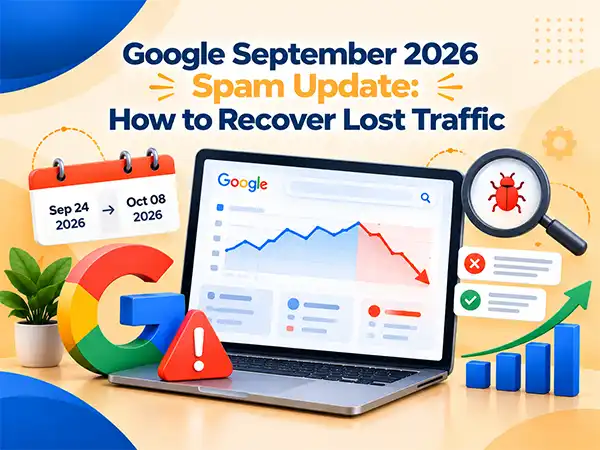
Has your website suffered a decline in organic traffic in the period from September 24, 2026, to October 08, 2026? It could be because of the Google September 2026 spam update; however, it does not guarantee that your website has been affected by it. Google completed the rollout of this update on October 8, and now website owners should focus on figuring out why there have been losses instead of making snap decisions.
This guide will help you to find out if your website got affected by the spam update, detect possible violations of spam policies, and create an action plan for recovery. You will also learn what practices to avoid after the spam update, how long it can take to recover, and what Google Search Console reports can be useful.
What Is Google’s September 2026 Spam Update?
The spam update of September 2026 was an update to Google Search rankings that worked to enhance the ability to spot spam. Google announced that it applies globally, in all languages. The implementation lasted almost two weeks and was over on October 8.
Spam updates are updates by Google that improve its automated systems that can detect search spam. Google’s SpamBrain is an AI-based spam detection system, not a type of spam update. Google’s spam updates improve its automated systems for detecting search spam and may affect the visibility of websites that violate its spam policies.
It is worth noting that not all website traffic drops necessarily indicate that the site in question has breached Google spam rules. The changes in ranking may be due to various factors such as technical issues, shifts in search queries, and intensified competition. For more causes, read why your site is not ranking on Google.
Therefore, the first step for websites that have been affected by the recent Google September 2026 spam update would be to ascertain if they suffered losses at the same time the changes were made and check which pages were responsible for this.
How Much Traffic Did Websites Lose After Google’s September 2026 Spam Update?
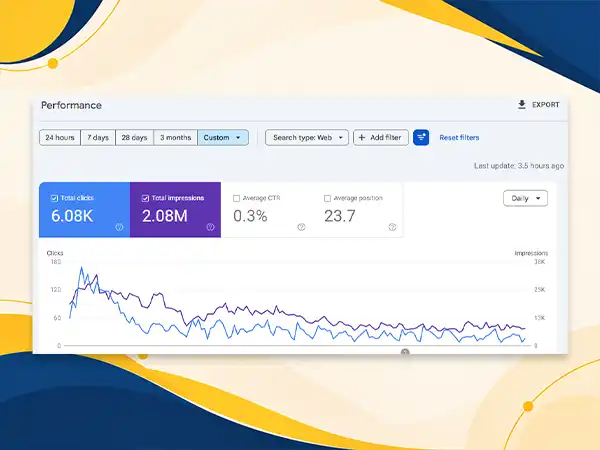
According to Diib’s October 9, 2026 report, which analyzed approximately 34,597 websites, 5.8% lost at least 50% of their unpaid Google search visits around the September spam update, compared with 1.3% during periods without a Google update.
These findings suggest that severe search traffic declines were more common around the update, although they do not prove that Google caused every loss. The study did not establish how many businesses closed or how much revenue they lost.
Businesses should review Google Search Console data, identify affected pages, and check for spam policy violations before making major website changes.
How to Recover from the Google September 2026 Spam Update: Step-by-Step
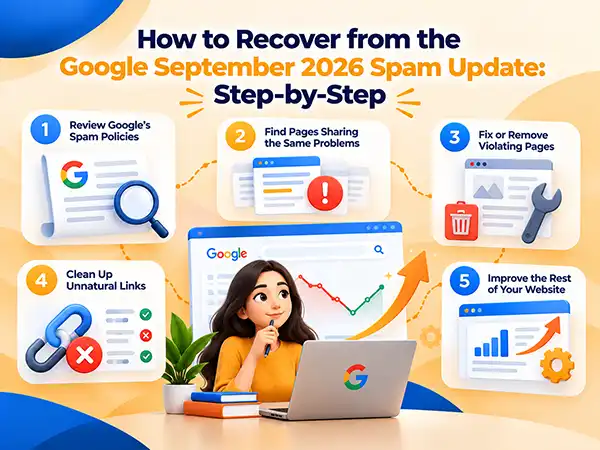
The first step in finding a sustainable recovery strategy is to discover the actual causes of problems and fix them. Changes made without proper reasoning, like altering your website, producing unnecessary content, or disavowing links, simply waste resources, while the root cause of your site’s traffic issue remains unaddressed.
Step 1: Review Google’s Spam Policies
Begin by reviewing Google’s spam guidelines for Google Search. Pay particular attention to tactics relevant to your website, including scraped content, link spam, keyword stuffing, and user-generated spam.
Scaled content abuse is the act of producing an excessive amount of non-original material to influence and manipulate search results rather than for the users’ benefit. The issue does not concern automation as much as the intention for producing such content.
Recovery checklist:
- Check the spam policy that is relevant to your business model.
- State the possible breaches rather than working on assumptions.
- Determine if the problem is connected only to some URLs or if it takes place for certain page types.
Step 2: Find Pages Sharing the Same Problems
When you comprehend the necessary regulations, assess the disadvantages pages have incurred.
Check for doorway pages, scaled content abuse, site reputation abuse, hacked content, and unnatural links. These issues may violate Google’s spam policies and require closer inspection.
If a local business’s website has hundreds of virtually identical service pages meant for different areas and these pages fail to offer sufficient information outside of changing location names, they require a closer inspection.
Similarly, if a publishing company employs huge quantities of automatically written articles, it should check whether they include some new and helpful information.
Recovery Checklist:
- Group URLs under a certain template, categories, and content type.
- Compare the pages that are losing ranking with those that are still performing well.
- Check for duplicated content.
- Check for user-generated spam in comments, forums, and profiles.
- Keep evidence for all the changes that are made.
Step 3: Fix or Remove Violating Pages
Not every page that is not performing as expected must be removed. Some pages may require significant updates, while in other cases pages may be useless, outdated or be created just to improve rankings.
Pages offering a relevant purpose should be improved if they lack detail, innovative ideas or actual significance. For pages that do not have any role, they should be either removed or merged with others. It is advisable to build redirects only when there is a real substitute for the deleted material.
If hackers have added spammy content to your website, you have to erase it and fix the security issue so that similar problems will not come up again.
The checklist for completing recovery includes the following activities:
- Improve the meaningful content of your material.
- Merge duplicate pages.
- Remove useless content.
- Update hacked and spammed materials.
- Check how linking and redirects work after your changes are performed.
Step 4: Clean Up Unnatural Links
Examine your backlink profile in case you have proof of paid linking schemes, link manipulation, as well as link schemes of other sorts.
Links used for ranking purposes are prohibited by Google’s link spam policy if they are deceptive as far as signals used in searching for information. Relevant links in terms of links and sponsorship paid links use rel=”sponsored” or “nofollow”, and user links use rel=”ugc”.
You should not assume that all low-quality or unknown backlinks are unhealthy. Not only is randomly denying links based on third-party toxicity scores an unreliable recovery method, but it is also ineffective.
Pay attention to backlinks that can be controlled or verified by you. Do your best to stop using manipulative SEO strategies and demand that links you have applied be removed or qualified correctly.
Step 5: Improve the Rest of Your Website
Compliance with spam policy is crucial, but it is also important to account for the accuracy and relevance of the entire site in your recovery strategy.
Look at the important pages to see if they provide answers to visitors’ questions, offer new information and help users perform what they wanted to do on the site.
Increase internal linking to help visitors find more related content. Work on the site’s usability and fix technical problems so that important pages can be found by search engines.
Do not create volumes of new content to make up for lost traffic. It makes little sense to publish additional pages before the old issues are resolved.
Recovery checklist:
- Improve on-page SEO for important landing pages.
- Provide original information for the benefit of users.
- Fix crawling and indexing problems.
- Get rid of manipulative SEO methods.
- Create a content review system.
Remove, Fix, or Keep? A Simple Recovery Checklist
When auditing a website after a spam update, divide weak pages into three groups.
| Decision | When to use it | Example |
| Fix | The page serves a useful purpose but needs substantial improvement | A service page with useful information but insufficient detail |
| Remove or consolidate | The page is redundant, offers no meaningful value, or violates spam policies and cannot be repaired effectively | Multiple near-identical pages created solely to target minor keyword variations |
| Keep | The page is useful and compliant, even if its traffic has declined | An original, informative guide that has lost impressions during the rollout |
This method ensures there is no indiscriminate massive deletion of web pages. Just because a page is losing traffic does not imply that it is a bad web page. Deleting useful content can lead to more difficult situations.
Take into consideration the page’s goal, usefulness, compliance with policies, originality, and performance metrics when making decisions.
If you require any assistance in executing this recovery plan, then Battersea Web Expert is an SEO agency in Delhi that can help you analyze the reason behind the drop in traffic, find possible problems on your website and formulate a recovery plan based on data and facts.
What NOT to Do After a Spam Update
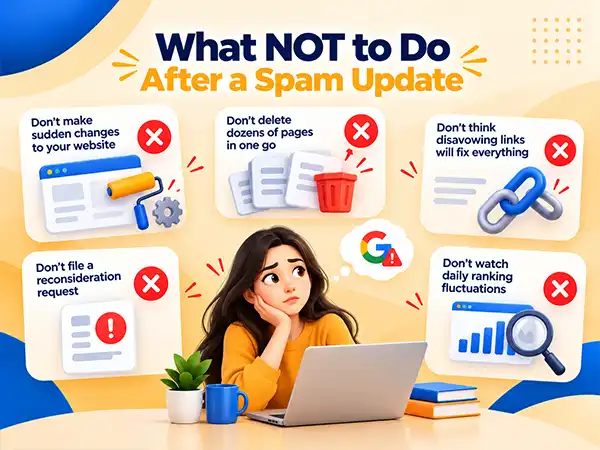
Panic can worsen an already difficult situation with regard to traffic decline. Make sure that you do not fall into the following traps during your work on the September 2026 spam update.
Do not make sudden changes to your website without a valid reason. A radical redesign can give rise to technical issues and complicate the search for the original reasons causing the decline.
Do not delete dozens of pages in one go. Remove or merge pages only after the audit confirms the necessity of such actions.
Do not think that disavowed links will change everything in terms of rankings. Google may already be ignoring artificial links, so disavowing them may not improve rankings.
Do not file one. It is only for manual actions. Reconsideration requests can only be applied to manual actions but not algorithmic ranking changes.
Do not watch daily movements in terms of rankings. Instead, pay attention to long-term tendencies and changes.
How Long Does It Take to Recover from a Spam Update?
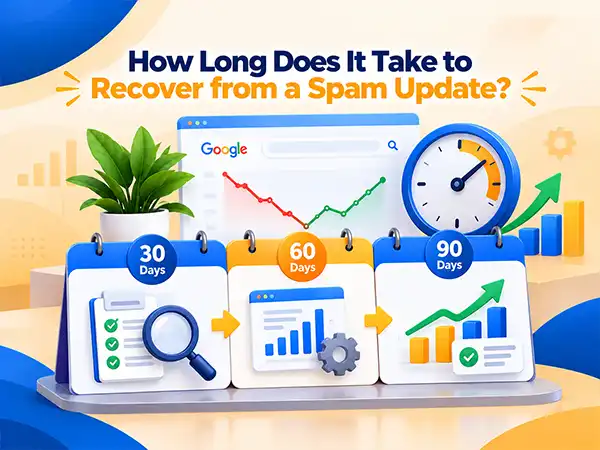
There is no fixed timeline for recovery after spam update of September 2026.
According to Google, once webmasters correct spam policy violations, their automatic systems may take several months to ascertain that a website has complied with its spam policies and then initiate recovery of the website.
Moreover, the duration of the recovery process is influenced by the particular nature of the violation. Fixing a handful of problematic web pages is not the same as dealing with extensive spamming.
Therefore, the following 30/60/90-day plan is recommended as a way to track progress after a spam penalty.
Track these numbers in your SEO reporting dashboard every month.
| Period | Actions | What to monitor |
| First 30 days | Complete the audit, correct verified violations, and resolve technical problems | Clicks, impressions, indexing, and completed fixes |
| Days 31–60 | Review the impact of changes and address remaining issues | Page-level trends, query performance, and new technical errors |
| Days 61–90 | Evaluate longer-term patterns and refine the recovery strategy | Sustained visibility changes, qualified organic traffic, and conversions |
These checkpoints are for evaluation and judgment, not recovery goals. Recovery may take longer than 90 days, and traffic may never return to normal levels.
You should continually assess performance and improve the site instead of frequently changing things to find a quick solution.
Can AI-Generated Content Cause a Google Spam Penalty?

Google does not penalize content simply because it is generated using AI. However, according to Google’s official spam policies, using AI to produce large amounts of unoriginal content without adding value for users may violate its scaled content abuse policy.
To reduce the risk, review AI-generated content for accuracy, add original insights and useful examples, and make sure every page meets a real user need. Focus on content quality rather than publishing large numbers of pages just to improve rankings.
Spam Update vs Core Update
Understanding the differences helps you choose the right recovery approach.
| Factor | Spam update | Core update |
| Cause | Automated spam detection and ranking changes | Broader changes to ranking systems |
| Search Console message | No message from Google. | No message from Google. |
| Recommended response | Review spam policies and correct violations | Evaluate content quality, relevance, and overall usefulness |
| Recovery time | May take months or longer | Varies; improvements may take time to be recognized |
A manual action and an algorithmic ranking adjustment are not the same thing. While Google has a reconsideration request feature for some manual actions, algorithmic spam updates don’t have that feature.
Was There a Core Update in September 2026?
The Google Search Status Dashboard has a record of the spam update released in September 2026; however, there is no record of any core update released in the same month. The core updates that have been documented for this year are the March core update and the May core update.
This fact is essential since it influences how you diagnose the problem of low traffic due to a spam update. A spam update only deals with spammy content in search results, while a core update involves general changes to Google ranking.
Google did not release a September 2026 core update. Instead, check whether your traffic decline coincided with the March 27 or May 21, 2026 core updates before attributing it to an algorithm change.
Your recovery plan should be based on the facts applicable to your website, rather than the assumptions made about the updates.
Frequently Asked Questions
Can a Site Recover After Being Hit by a Spam Update?
Yes, recovery is possible, but it is not guaranteed. Website owners should identify and correct violations of Google’s spam policies, remove manipulative practices, and improve affected pages. Google may need months to recognize sustained compliance, so meaningful recovery can take time.
Is There a Reconsideration Request for a Spam Update?
No. Reconsideration requests are intended for eligible manual actions, not algorithmic spam updates. If your site has no manual action, focus on diagnosing the traffic decline and correcting any verified policy violations rather than waiting for a review request.
Will Disavowing Links Help?
Not necessarily. Disavowing links is not a guaranteed way to recover rankings after a spam update. First, investigate whether your website has participated in manipulative link schemes. Google may neutralize the ranking benefits of spammy links, and those benefits cannot necessarily be regained.
How Long Does It Take to Recover from a Spam Update?
Recovery can take months or longer. Google explains that its automated systems may need time to recognize that a website complies with its spam policies. The timeline depends on the issues involved, the corrective work completed, and how the site’s performance changes over time.
Was There a Core Update in September 2026?
Google’s official Search Status Dashboard lists the September 2026 spam update but no September 2026 core update. The documented core updates earlier in 2026 included the March and May updates. Always verify update dates against Google’s official records. To follow other recent Google changes, read about SynthID and SEO.
I Lost Traffic on September 23. Was It the Update?
A decline beginning on September 23 predates Google’s September 24 spam update announcement. The update is therefore unlikely to explain the beginning of that decline. Investigate earlier site changes, search demand, tracking issues, and other potential causes.
Conclusion: Build a Sustainable Recovery Plan
The process of recovering from Google’s spam update of September 2026 begins, not with assumptions, but with investigation. Start by checking your Search Console and understanding which of your web pages have been affected. Read Google’s guidelines on spam, remove the violations you may have made, and keep an eye on your results regularly.
Refrain from deleting your pages in bulk, redesigning them needlessly, or claiming that you will recover your search visibility overnight. Real change requires taking action based on proven techniques and regular measurement.
Want help understanding what has caused your traffic fall-off?
In such cases, a detailed SEO audit can help detect any problems related to content, technical and link issues, and make sure to take the necessary steps based on it.