
- 10 SEO Strategies at a Glance
- Strategy 1: Start With Search Intent and Keyword Research
- Strategy 2: One Page, One Main Keyword
- Strategy 3: Set Up and Optimise Your Google Business Profile
- Strategy 4: Build Strong Local SEO
- Strategy 5: Fix Your On-Page SEO Basics
- Strategy 6: Get the Technical Basics Right
- Strategy 7: Create Helpful Content and FAQs
- Strategy 8: Collect and Reply to Reviews
- Strategy 9: Build Local Links and Mentions
- Strategy 10: Track Results and Improve Every Month
- What Is an SEO Strategy for a Small Business?
- Why SEO Matters for Small Businesses
- How to Get Found in AI Search (AI Overviews, ChatGPT, Perplexity)
- Best SEO Strategies by Business Type
- 6 SEO Mistakes Small Businesses Should Avoid
- 90-Day SEO Action Plan
- Can You Do SEO Yourself or Should You Hire an Agency?
- How Small Businesses in India Can Use AI to Grow Their Business
- Conclusion
- Frequently Asked Questions
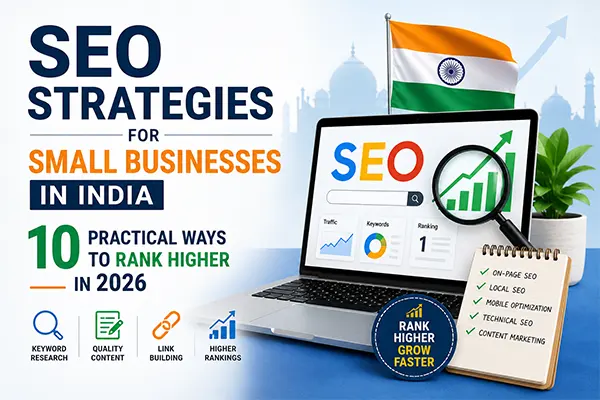
Running a small business in India means balancing customer demands, daily operations, and a limited marketing budget. With so much to manage, SEO can feel complicated, especially when you have a small budget and little time. However, improving your online visibility doesn’t have to mean spending more or doing everything at once.
According to the Google Ads & Commerce blog, searches for “local businesses” grew by over 80% year over year, highlighting the importance of being visible when potential customers search online. The right SEO strategies for small businesses can help you connect with people who are actively searching for your products or services.
In this guide, you’ll discover 10 practical strategies to improve your search visibility without stretching your resources. You’ll also find a simple 90-day plan to help you decide what to do first, which improvements to prioritize next, and how to measure your progress over time.
10 SEO Strategies at a Glance
Before jumping into details, we have presented a quick overview of 10 practical SEO strategies for small businesses in India. Use this table to compare each technique and determine when you might start seeing results.
Remember, the mentioned timelines are estimates, as actual results depend on your website complexity, competition, and consistent efforts.
| S.No. | Strategy | Effort | Indicative Time to Assess Impact | Best For |
| 1. | Search Intent and Keyword Research | High | 1–3 Months | Businesses that rely on organic search traffic, digital lead generation, or online sales. |
| 2. | One Page, One Main Keyword | High | 1–3 Months | Businesses with existing websites. |
| 3. | Set Up and Optimise Your Google Business Profile | Medium–High | 2–8 Weeks | Local Businesses |
| 4. | Build Strong Local SEO | Medium | 2–6 Months | Shops and Local Service Providers |
| 5. | Fix Your On-Page SEO Basics | Low–Medium | 2–6 Months | Small Businesses, Local Service Providers, and Content-Driven Websites. |
| 6. | Get the Technical Basics Right | Medium–High | 2 Weeks to 6 Months | Small businesses with technical SEO issues, slow-loading websites, or multi-regional websites. |
| 7. | Create Helpful Content and FAQs | Medium–High | 2–6 Months | Service Businesses, Stores, and Professionals |
| 8. | Collect and Reply to Reviews | Low | Ongoing | Customer-Facing Businesses |
| 9. | Build Local Links and Mentions | Medium–High | 2–6 Months | Established Local Businesses and Growing Brands. |
| 10. | Track Results and Improve Every Month | Low–Medium | Review Monthly | Every Business |
Strategy 1: Start With Search Intent and Keyword Research
Start your SEO campaign with keyword research. It helps you understand what potential customers type into Google when they are looking for your product or service. Search intent refers to the reason behind a search, such as whether users want information, to compare options, to find a nearby provider, or to make a purchase.
There are four different types of keywords:
- Informational: Users want to learn something or want a guide (e.g., “What is interior design?”)
- Commercial: Users are researching and comparing products or services before making a purchase (e.g., best SEO tools for small businesses).
- Transactional: Users are ready to buy or act (e.g., buy black running shoes online)
- Navigational: Users want to reach a specific site or a page (e.g., “HDFC Bank net banking login” or “Zomato restaurant partner login”)
How To Do Keyword Research
- Define Your Goals: Identify your primary business objectives. Whether you want e-commerce sales, lead generation, or brand awareness, before starting the keyword research work. It will help you choose relevant search terms for your website content.
- Categorize Search Intent: Determine what your targeted audience wants to achieve with their searches. For instance, “how to do SEO for small business” reflects a need for information. While “SEO services for small businesses in Delhi NCR” indicates that the user may want to hire a professional.
- Use Research Tools: Make use of any free keyword research tools, such as Google Keyword Planner, Google Trends, Google Autocomplete, People Also Ask, or Google Search Console, to find relevant search terms and discover emerging trends. Also, by doing this, you can precisely understand how your potential customers search for your product/service.
- Target Low-Competition Keywords: Prioritize specific, relevant long-tail keywords that give smaller websites a realistic chance of ranking. For example, a bakery in Janakpuri can target “custom birthday cakes in Janakpuri” instead of the broad term “cakes”. It can also publish a guide explaining how to choose birthday cakes for different occasions.
- Match Format to Intent: Align your website content format with the user search and intent accurately. Create blog posts for informational searches, comparison pages for option evaluation, and product/service pages for visitors who are ready to buy.
Point to Remember: Do not assess keywords by only relying on competition alone; focus on their search volume, relevance, and difficulty too. The selected search term must perfectly align with your actual offering and the page you intend to create.
Strategy 2: One Page, One Main Keyword
After identifying the focus keyword for your website content, assign one main keyword to each web page to keep your content clear and useful while preventing keyword cannibalization. This process is known as keyword mapping, which allows you to organize your content and reduces unnecessary overlap between internal pages.
Here’s an example of keyword mapping. Take a look.
| Website Page | Target Keyword |
| Homepage | Clothing Store in Delhi |
| Local SEO Page | Women’s Ethnic Wear in Delhi |
| Technical SEO Page | Cotton Kurti For Women |
| Blog Post | How to style kurtis for everyday wear |
Example: A dental clinic in Rohini can target “dental clinic in Rohini” on its homepage and “teeth cleaning in Rohini” on a service page. Alongside, it can use “how often should you get teeth cleaned?” in a blog post.
How To Do Keyword Mapping
- Open a spreadsheet using Excel or Google Sheets and create the following dedicated columns:
- Existing website URLs.
- Target URL or Planned New URLs
- Page Type
- Primary Keywords
- Secondary/Supporting Keywords
- Search Volume & Keyword Difficulty (KD)
- On-Page Elements (Title, H1, Meta Title, Meta Description, and the rest).
- Add one relevant main keyword to each page.
- Use useful secondary search terms in headings and content effectively.
- Check whether your existing two pages answer the same search intent query.
- If any, decide to differentiate their purpose, consolidate them, or redirect outdated pages (when appropriate).
The aim is not to restrict each page to one exact phrase but to establish a clear primary topic and distinct purpose for each web page of your website.
Point to Remember: Do not create a separate page for every keyword variation.
Strategy 3: Set Up and Optimise Your Google Business Profile
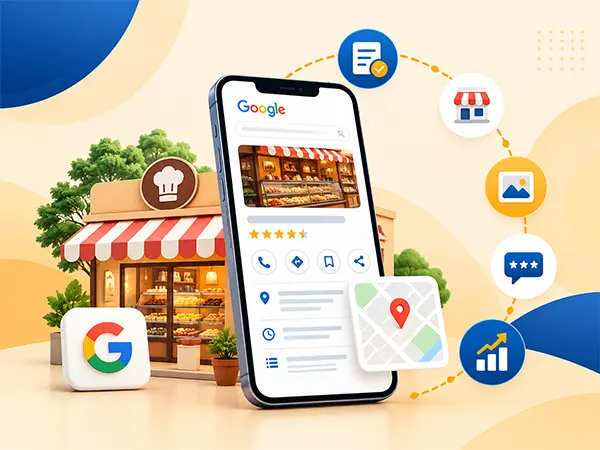
A Google Business Profile (formerly known as Google My Business) is a free tool from Google that helps small businesses control how their company appears in Google Search and Google Maps.
Notably, for a shop, clinic, restaurant, or any other service provider that meets customers in person, Google Business Profile optimization is often one of the most practical places to begin local SEO.
How to Optimize Your Google Business Profile (GBP)
- Claim and Verify Your GBP: Use the official Google Business Profile website, fill out all the necessary information, and complete the verification method offered to your business.
- Choose the Accurate Primary Category: Select the category that perfectly describes your main business activity. Alongside, add relevant secondary categories only when appropriate.
- Complete Your Business Information: Use the real business that is legally registered or shown on your shop board, address, phone number, service area, operating hours, and available services.
- Add Genuine Photos: Show your business premises, products, team, equipment, or completed work to your audience through clear, current images.
- Update Your Services: Add your relevant service descriptions, keep holiday hours accurate, publish useful updates, and pricing (when appropriate).
- Respond to Customer Reviews: Professionally respond to all positive and negative reviews you get on your GBP to maintain a smooth, trustworthy relationship with your visitors.
Example Profile: “Sharma Sweets & Bakers” (Lajpat Nagar, New Delhi)
- Business Name: Sharma Sweets & Bakers
- Primary Category: Mithai/Sweet Shop
- Secondary Category: Bakery (if applicable)
- Address: Shop 12, Central Market, Lajpat Nagar, New Delhi, Delhi 110026
- Services: Sweets, Bakery Items, and Custom Cakes
- Opening Hours: Monday–Sunday 9:00 AM–10:30 PM
This example illustrates how accurate business details can help customers discover and evaluate your local business online.
Point to Remember: In Google Business Help documentation, Google suggests not adding extra keywords to your business name unless they are genuinely part of the real-world name. Also, do not create multiple profiles for the same eligible business location; create a new profile only for a genuine, eligible branch with a staffed address, not each neighbourhood area you serve.
Strategy 4: Build Strong Local SEO
Local SEO helps you rank your business on Google Maps while making it more visible for searches connected to a particular city, neighbourhood, or service area. Evidently, it is especially useful for businesses that are targeting customers from nearby locations.
For example, a bakery owner might want their storefront to appear for “custom birthday cake in Janakpuri” while a digital marketing agency may target customers searching for “Local SEO consultant in Pitampura”.
How to Perform Local SEO
Here we have presented some effective local SEO strategy for small business. Check them out.
- Optimize Your Google Business Profile (GBP): As covered in Strategy 3, keep your profile complete and accurate, update business information regularly, and respond to customer reviews professionally.
- Keep Your NAP Details Consistent: Ensure you maintain accurate, consistent name, address, and phone number (NAP) across all your digital channels, including your website, GBP, and relevant online directories.
- Target Local Keywords: Research search terms that combine your services with specific locations. For example, a digital marketing agency in Delhi might target “digital marketing company in Rohini” or “digital marketing agency in Pitampura” based on the areas they operate.
- Use Location Terms Naturally: Try to include relevant city, neighbourhood, or service-area names in your page titles, headings, and content where they make sense. However, do not overdo it; avoid repeating location keywords unnaturally or adding places you do not operate in.
- Create Dedicated Service & Location Page: If you serve in multiple areas or offer different services, create useful pages for each relevant service and location, including service details, local information, and clear contact options.
- Build Relevant Directory Listings: Try to list your business in reputable local directories and industry-specific platforms. However, avoid spammy sites or forums that are created solely for backlinks.
- Make Contacting You Easy: Display your phone number, business address, opening hours, WhatsApp contact option, and contact forms prominently on your website. Additionally, add a map or directions where useful and expected response times.
Example: A home cleaning service in Delhi can target searches such as “deep home cleaning in Dwarka” to reach more specific location-based customers. They can also create a dedicated service page with available cleaning packages, nearby areas covered, and booking details that helps attract relevant local customers and generate enquiries.
Point to Remember: Do not publish dozens of near-identical location pages. Ensure your each location/service page is unique and useful for your customers.
Strategy 5: Fix Your On-Page SEO Basics
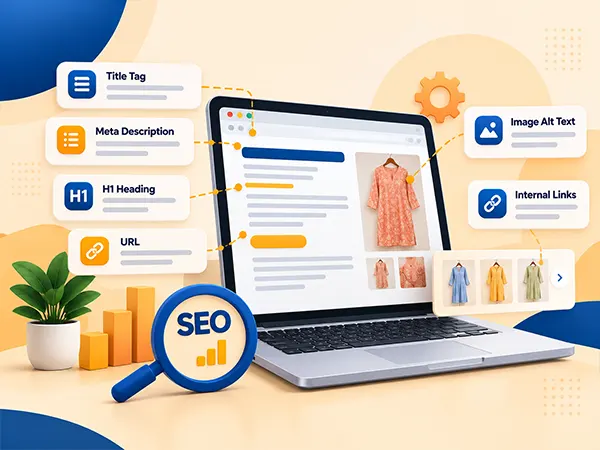
On-page SEO for small business involves improving the essential elements of your web page so that both search engines and your visitors can easily understand its context and purpose. For this, you do not have to make major technical fixes; small changes surely make a big impact.
Thus, focus on the following elements:
- Title Tag: Write a descriptive title that includes your focus keyword, reflecting the page’s main topic precisely.
- Meta Description: Summarize the page accurately and give searches a reason to visit.
- H1 Heading: Use a clear main heading that tells visitors what the page covers.
- URL: Try to keep your URL clear, readable, and relevant. Avoid unnecessary parameters.
- Image Alt Text: Describe your image accurately for users, but do not force keywords into it.
- Internal Links: Link your related pages to each other using descriptive anchor text.
Example: A clothing store in Karol Bagh selling cotton kurtis can optimize its product page with a title like “Buy Cotton Kurti in Karol Bagh”, detailed fabric, and sizing information. It can also use high-quality images with descriptive alt text and add links to matching dupattas or other kurti styles to help shoppers explore related products.
Point to Remember: Do not use the same keywords throughout the content unnaturally. According to the Google Search Central blog, Google’s automated ranking systems prioritize helpful, reliable content, so try to write for people first, using related phrases.
Strategy 6: Get the Technical Basics Right

Technical SEO helps search engines access your website and understand which pages may be eligible to appear in search results. Also, it supports a better experience for visitors.
You can start your technical SEO for small business with these six fixes:
- Mobile Usability: Ensure your website text is readable, menus work, buttons are easy to tap, and contact forms can be completed without difficulty on smartphones.
- Page Speed: Test your key pages using PageSpeed Insights. Instead of chasing a perfect score, prioritise problems that negatively affect your loading speed, improving user experience.
- HTTPS: Ensure your website uses HTTPS and has a security certificate, delivering secure interface version to your visitors.
- XML Sitemap: Accurately prepare a sitemap listing the important URLs you want search engines to discover.
- Robots.txt and Indexing: Check your robots.txt file to ensure it does not block any important pages, and verify that the pages you want to appear in search results are indexable.
- Structured Data: Add relevant structured data to help search engines understand your content and make your pages eligible for enhanced search result features.
How to Perform Technical Fixes
Identify errors that prevent customers or search engines from accessing important pages. Below is a quick technical SEO audit checklist. Check it out.
- Fix broken links and pages that return errors.
- Ensure important pages can be easily found and indexed by search engines.
- Check that your website works properly on mobile devices.
- Make sure website navigation is simple and user-friendly.
- Compress images to help pages load faster.
- Use HTTPS to protect data exchanged with your website.
- Remove unnecessary redirects or redirection loops.
- Create a clear website structure with logical page links.
- Check that important buttons, forms, and contact links work correctly.
- Review Google Search Console for indexing or other website errors.
Example: A coaching institute in Laxmi Nagar can use Google Search Console to find unindexed course pages, fix broken admission links, and improve slow-loading pages. These fixes help students/parents discover courses through Google and navigate the website more easily.
Besides, review Google Search Central’s guide to learn some basic and practical fundamentals of managing your website’s technical SEO for small business.
Point to Remember: Do not install multiple SEO plugins, change URLs, or add schema code without understanding the consequences. Also, try to keep backups and ask a developer for help with changes that could potentially affect your entire website.
Strategy 7: Create Helpful Content and FAQs
Semrush blog states a useful content strategy that directly answers the user questions asked before, during, and after a purchase, establishing your expertise while creating more opportunities to appear for relevant searches.
How to Build a Practical Content Strategy For Small Business
Here, we have presented a few effective SEO content writing tips. Take a look.
- Create a Main Service or Topic Page: Build a comprehensive page around your primary topic or service, covering key offerings, benefits, essential information, and common customer concerns.
- Publish Supporting Articles: Write blog posts that answer related questions and link them naturally with your main service or topic page, helping users explore relevant information.
- Add FAQs Based on Real Customer Questions: Cover questions from customer conversations, sales enquiries, and search results to make your content more concise and helpful.
- Demonstrate First-Hand Experience: Try to include original case studies, examples, practical insights, or factual statistics to boost your content authenticity and credibility.
- Keep Your Content Accurate and Updated: Regularly review your important pages to correct outdated information, refresh examples, verify facts, and ensure your content precisely aligns with customer needs.
Example: An interior designer in South Delhi can create a guide titled “2 BHK Interior Design Cost in Delhi” with room-wise expenses, estimated budget, space-saving ideas, and common budgeting mistakes. Also, adding practical FAQs and links to relevant design services helps readers plan their projects and explore more suitable solutions effectively.
Point to Remember: Avoid publishing dozens of thin, repetitive articles without any meaningful review or original insights. Remember, publishing more content is not automatically the best SEO strategy.
Strategy 8: Collect and Reply to Reviews
According to the Forbes blog, reviews help potential customers evaluate your business before contacting you. Whether positive or negative, both reviews potentially describe your service, responsiveness, professionalism, and overall customer experience.
How to Build a Simple Review Process
- Ask at the Right Moment: Do not force a review in the initial stage. Professionally ask for honest feedback after completing a project, delivering an order, or resolving a customer issue.
- Make Reviewing Easy: Share your direct Google review link through WhatsApp or email, where appropriate. This will help your customers easily leave feedback without any hassle.
- Respond Consistently: No matter whether you receive a positive or a negative review, respond professionally. Thank your customer for good feedback and address concerns politely. Also, avoid revealing personal or confidential information in public replies.
Example: To ask for honest feedback, a car repair center in Pitampura can display a Google review QR code at its billing counter or send a polite WhatsApp reminder after completing the servicing. Also, responding to reviews and addressing customer concerns can build trust and help attract new visitors.
Point to Remember: Never buy fake reviews, offer prohibited incentives, or ask only satisfied customers to post public feedback in a way that manipulates your ratings.
Strategy 9: Build Local Links and Mentions
Link building is the practice of earning hyperlinks (called backlinks) from other websites that directly point to your own website. A relevant link can help your potential customers discover your business and provide useful context about your reputation.
Additionally, local mentions without links can also help increase brand awareness and build familiarity with your target audience.
How to Earn Relevant Links
- Create Link-Worthy Content: Try to publish useful guides, industry insights, or practical resources that other websites may find valuable enough to reference and link to.
- Reach Out to Relevant Websites: Contact publishers, industry-related websites, and bloggers with helpful content suggestions that genuinely benefit their audience.
- Build Local Partnerships: Collaborate with local businesses, industry associations, and community organizations to earn relevant links through genuine partnerships, events, or joint projects.
- Write Guest Posts: Contribute informative articles to reputable websites in your industry. Offer them relevant insights to their reader while earning reputable editorial links.
- Reclaim Unlinked Brand Mentions: Find websites that mention your business without linking to your site. If you find any, professionally ask the business owner or website editor to add a link to redirect their traffic to your business.
Example: A wedding photographer in Delhi can partner with banquet halls, bridal boutiques, and wedding planners to create vendor guides or showcase real wedding projects on their websites. These collaborations can earn relevant backlinks, strengthen local visibility, and help couples discover the photographer while researching wedding services.
Bonus Tip: You can reach out for professional white-hat link building for small business to develop a sustainable outreach process for your business growth.
Point to Remember: Never buy backlinks, participate in link schemes, or publish low-quality guest posts just to manipulate rankings.
Strategy 10: Track Results and Improve Every Month
Remember, SEO is not a one-time task; to maintain effective outcomes, it requires constant review and changes. However, you do not need any premium tool or a complicated dashboard to start. Free tools like Search Console and Google Analytics (GA4) provide a useful foundation to track SEO results effectively.
Here are five important metrics you must track.
- Impressions: Helps to determine how often your website appears in Google Search.
- Clicks: Identify how often people click on your website from Google Search.
- Keyword Visibility: Suggests whether your important queries are becoming more visible.
- Calls and Leads: Indicates whether visitors are taking meaningful business actions.
- Reviews: Helps to demonstrate how customers are reviewing your product or service.
How to Review Your SEO Performance Monthly
To review your website performance, prepare a detailed monthly SEO reporting dashboard that perfectly presents all the essential metrics altogether. Below is what you can do.
- Create a simple summary to review all the important results collectively.
- Compare the latest month’s performance with the previous reporting period.
- Compare the same period data with the previous year (when enough historical data is available).
- Identify pages and queries that are potentially gaining or losing visibility.
- Check whether your organic visitors are submitting forms, calling, booking appointments, or purchasing products.
- Look at how often your website gets cited, mentioned, or recommended on AI systems like ChatGPT, Gemini, or others.
- Choose two or three improvements for the next month and measure their effects consistently.
Example: “Dilli ka Cafe” in Connaught Place can use Google Search Console to identify which searches bring visitors to its website. By improving pages with low clicks and tracking table bookings, menu views, and received enquiries in a month, the cafe can measure SEO performance to attract more local customers.
Point to Remember: Do not change your entire SEO strategy because of a few days’ fluctuations. Try to focus on meaningful trends and thoroughly examine possible causes before acting to prevent unintentional damage to your website.
What Is an SEO Strategy for a Small Business?
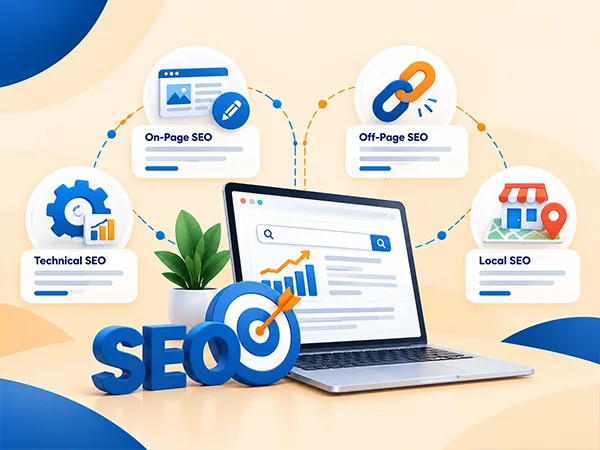
A small business SEO strategy is a planned approach to improving a business’s visibility in organic search results so that potential customers can discover your products or services without relying on paid advertising. It combines relevant keyword research, useful content, technical improvements, and local visibility to attract people who are likely to become customers.
Here are the four main components of SEO strategies for small businesses; take a look.
- On-Page SEO: The practice of optimizing an individual web page, including titles, headings, URLs, content, images, and internal links, so that search engines and visitors can find and understand your website content easily.
- Off-Page SEO: Includes all activities taken outside of your own website to build its search engine rankings, authority, relevance, and trustworthiness through backlinks, business mentions, partnerships, and genuine customer reviews.
- Technical SEO: The practice of optimizing and strengthening a website’s infrastructure so that search engines and AI systems can easily find, crawl, render, and understand its content while delivering a usable experience across devices.
- Local SEO: The practice of optimizing a business’s online presence to target location-based searches on platforms like Google Search, Google Maps, and AI search engines. For example, “Car Service in Rajendra Nagar” or “AC Repair Near Me”.
For example, a Delhi-based dentist might publish a helpful guide, dedicated service page, maintain a Google Business Profile, and get mentions from other authentic healthcare directories to build a strong online presence.
Point to Remember: According to Google Search Central’s SEO Starter Guide, these components work together to improve a website’s search visibility and online presence.
Why SEO Matters for Small Businesses
Nowadays, customers often research businesses online before deciding whether to contact them, make a purchase, or book a service. Therefore, appearing for relevant searches may allow you to reach potential customers when they are actively looking for your product or services online, making SEO strategies for small businesses very important.
Besides, below are some important reasons search engine optimization matters for small businesses, according to top SEO experts in India. Check them out.
- Reduce Long-Term Dependence on Paid Advertising: Unlike paid advertising, which often stops generating traffic when your budget ends, SEO can help you attract more potential customers through organic search. Although acquiring organic traffic through SEO requires time, consistent efforts, and investment to deliver results, well-optimized pages that provide genuinely useful information can continue attracting relevant visitors long after publication.
- Helps Build Trust and Discoverability: SEO strategies like keyword optimization, quality backlinks, and an accurate Google Business Profile help potential customers find your business, compare services, and book appointments. Also, helpful content, genuine reviews, and consistent business information strengthen the overall brand’s credibility and encourage customer confidence.
- Adapt to Changing Search Behaviour: According to the Google blog, search is evolving toward more conversational queries and an AI-powered experience; SEO helps small businesses adapt by targeting relevant keywords, answering specific questions, and optimizing web pages.
Therefore, these practices make it easier for potential customers to discover, compare, and make a purchase from your brand effectively.
How to Get Found in AI Search (AI Overviews, ChatGPT, Perplexity)
Optimize your website’s content for Generative Engine Optimization (GEO) to get mentioned, cited, or recommended by AI-powered platforms like Google AI Overviews, ChatGPT, or Perplexity.
However, according to Google Search Central documentation, SEO practices remain relevant and significant to AI Overviews and AI Mode. There is no special optimization, AI Overviews SEO, or additional structured-data requirement that guarantees inclusion. GEO has not replaced SEO; in fact, it serves as an extension of it!
Besides, here are a few practical ways to improve discoverability across AI Search for small businesses. Take a look.
- Directly Answer User Query: Start your writing by directly addressing the user queries, then provide the explanation, steps, and context. For example, an article about SEO services in Delhi should first explain what SEO services include before discussing their benefits and pricing.
- Maintain Structured Content Hierarchy: Use proper H2 and H3 headings, short paragraphs, tables, bullet points, and logical & descriptive sections, helping search engines, AI bots, and visitors easily interpret the page content.
- Add Original, Useful Insights: Try to add first-hand experience, expert reports, authentic research work, valuable examples, accurate product/service details, and original photos (when relevant), supporting your published information with authentic sources.
- Strengthen Topical Coverage: Instead of publishing generic, thin content that just focuses on a broad keyword, cover relevant subtopics, related questions, and entities. This helps you cover the targeted user search intent comprehensively.
- Maintain Strong Technical Accessibility: Ensure your important content has readable text, can be crawled & indexed, and internal links help users discover related information effortlessly. So that search engines and AI bots can discover, read, and interpret your website without fail.
- Keep Business Information Consistent: Make sure your business information, including name, address, contact details, operating hours, and locations, is accurate across all your digital channels (website/relevant public profiles).
Best SEO Strategies by Business Type
Forbes blog stats that SEO is not a one-size-fits-all solution, highlighting how different types of businesses need to prioritize distinct SEO strategies. Notably, each brand has its own niches, targeted audience, location, and offerings; what works for one doesn’t mean that goes with the other too.
This section explains which SEO strategy for local business should be prioritized first and which strategies can be implemented later. Take an attentive look for a better understanding.
| Business Type | Top Priorities | What to Postpone |
| Local Shop or Clinic | Google Business Profile Optimization, Location-Specific Website Content, and Local Citation Consistency | Broad Global or National Keyword Targeting, Massive Content Blogging & Guest Posting, and Complex Multi-Location or Enterprise Schema. |
| Service Provider (Visit Customer) | Built-Out City & Service Landing Pages, High-Intent Keyword Targeting & UX, and Continuous Review Acquisition & Local Signals | Generic content, unnecessary neighbourhood pages, and storefront address listings. |
| Online Store | Technical Architecture & Site Structure, Keyword Research & Intent Mapping, Unique Product & Category Content, On-Page & Meta Optimization, and Mobile Friendliness & Core Web Vitals (CWV) | Aggressive Off-Page Link Building / Guest Posting, Extensive Custom Schema Beyond Basics, and Excessive Third-Party SEO Apps & Plugins |
| Online Service Provider or Coach | E-E-A-T & Authority Building, Technical Fundamentals & Local SEO, High-Priority Intent & Keyword Research, and On-Page & Messaging Optimization | Ultra-Competitive Broad Keywords, Multi-Channel Content Scaling, and Paid SEO Software Subscriptions |
6 SEO Mistakes Small Businesses Should Avoid
Below, we have listed some crucial yet common SEO mistakes small business often make. Check them out and try to avoid them in your content next time.
- Keyword Stuffing: Repeating the same keywords excessively in your text, titles, and content unnaturally may trigger Google spam penalties. Try to include your target search term in relevant headings, the introduction, and somewhere in context, and simply explain your topic.
- Copied Location Pages: Publishing identical, thin location pages for different location or neighbourhood areas may cause duplicate or cannibalization issues, leading search engines to ignore or filter out your web page. Thus, always make your location/service page unique with valuable information and accurate business information.
- Ignoring Mobile Usability: According to Statista, mobile devices account for over 50% of global web traffic, highlighting the importance of mobile optimization for local searches. Slow-loading, difficult-to-navigate, or unresponsive web pages leave users frustrated and may potentially drop your SERP ranking. Ensure your website is performing well on all devices, including desktop and mobile phones.
- No/Inaccurate Google Business Profile: An incomplete, unclaimed, or inactive Google Business Profile may make your business invisible from Google Maps or local search results. Update your information, fill in all the required information precisely, and respond to your customer reviews in a timely manner.
- Inconsistent NAP (Name, Address, & Phone Number): Having inconsistent business information, like name, address, phone number, operating hours, and other essential details across your website, GBP, or other digital channels may confuse search engines. This can also negatively affect the brand’s reputation and credibility. Ensure all your details are accurate and try to update your old listing when your details change.
- Expecting Results in 2 Weeks: There is no universal timeframe for when SEO delivers results. Evidently, according to Google documentation, some improvements may take a few months to be assessed by its system; however, rankings are never guaranteed.
90-Day SEO Action Plan
You don’t have to work on all 10 mentioned SEO strategies all together. If search engines cannot understand your niche/content or fail to index/crawl, all your future efforts will fail to perform.
Thus, check out the following 90-day small business SEO plan to determine how you can work on your website step-by-step.
Month 1: Set Up the Foundation
In the initial stage, keep your entire attention on creating a strong website foundation. For this, you can do:
- Make use of any premium or free keyword research tool to identify relevant, high-intent keywords and customer questions to understand what your audience expects from you.
- Map one major topic to each of your important pages.
- Create/update your Google Business Profile accurately.
- Set up Search Console and GA4.
- Check HTTPS, key technical errors, indexing, and mobile usability.
- Conduct a quick SEO audit to identify technical issues, content gaps, and opportunities for improvement.
Month 2: Improve Pages and Local Visibility
After establishing the website foundation, spend your time improving published pages and improving local visibility and discoverability by following these methods:
- Rewrite/update your priority page titles, headings, outdated information, and factual data.
- Improve your service/product description with accurate details and add high-intent keywords.
- Start link building and improve the existing ones so that search engines and users can easily understand the relationship between all important pages.
- Fix technical issues so users and search engines can access and navigate important pages easily.
- Correct/update your old business listing across all your digital channels and industry directories.
- Start publishing 1–2 useful blogs and valuable FAQs based on your targeted audience search intent.
Month 3: Build Trust and Refine Performance
After entering the final stage, your priority must move from foundation and content or visibility to trust and refining website performance. For this, you can perform the below-mentioned techniques.
- Focus on acquiring genuine, honest reviews from your customers.
- Professionally respond to both positive and negative reviews.
- Contact relevant local partners or publications for more local citations.
- Compare your Search Console and GA4 performance with the baseline to determine the improvements and areas that still need more attention.
- Fix all the crucial errors you found in the SEO audit to improve your website performance.
Can You Do SEO Yourself or Should You Hire an Agency?
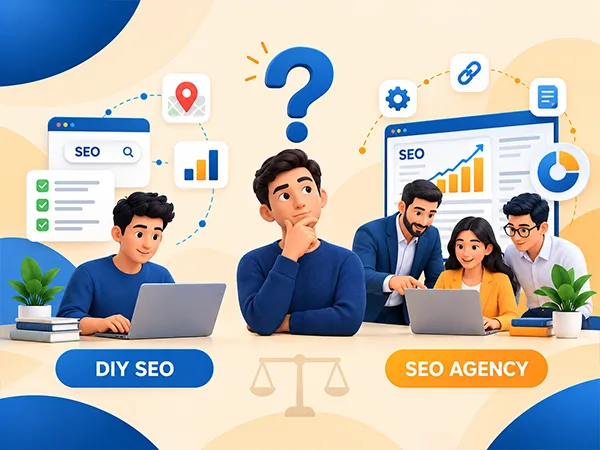
You can handle many SEO basics yourself, particularly when you run a small business with a simple website. Google Business Profile updates, basic on-page optimization, keyword research, review requests, and monthly performance checks are practical starting points that you can easily do.
However, DIY SEO for small business becomes harder when you technically have a complex website, strong competitors, hundreds of product pages, a content backlog, or a need for structured link-building outreach. At that stage, it is better to compare hiring a freelancer or an agency. A professional may help you identify priorities, avoid costly errors, and implement effective SEO strategies consistently.
How Small Businesses in India Can Use AI to Grow Their Business
According to a Meta Newsroom report, 94% of surveyed tech-enabled Indian MSMEs acknowledged AI’s potential to drive business growth, highlighting growing interest in AI as a practical tool for improving operations.
Here are some ways small businesses can get started:
- Daily Operations & Admin: Automate repetitive tasks such as data entry, invoicing, appointment scheduling, inventory updates, and payment reconciliation.
- Improve Customer Support: Use AI-assisted tools to answer common customer queries about products/services, pricing, delivery, and business information. For example, a Delhi-based bakery can use AI to respond quickly to cake-order enquiries.
- Automate Customer Communication & Follow-Ups: Use AI-powered chatbots on WhatsApp and your website to respond to customer queries 24/7 and automatically send instant replies and follow-ups to new sales leads.
- Content & Marketing: Easily generate multilingual social media posts, product descriptions, blog outlines, email campaigns, and FAQs in minutes. However, review content for accuracy before publishing.
- Sales & Inventory Forecasting: You can make use of AI analytics to predict product demand, manage stock levels, identify high-value leads, and improve sales conversions effectively.
Point to Remember: AI should support your expertise, not replace human judgement. Do not publish unverified or repetitive content, and protect your customers’ sensitive information, preventing any sort of internet hazards.
Conclusion
Effective SEO strategies for small businesses do not require you to do everything at once. You can start by updating your Google Business Profile, conducting customer-focused keyword research, and mapping your main pages. Then improve your website’s technical foundations, publish useful content, collect genuine reviews, and build authentic, relevant local relationships.
If you need expert support to turn these actions into a structured plan, explore our prominent SEO services in India and identify the next step that best fits your business.
Frequently Asked Questions
How long does SEO take for a small business?
SEO typically takes 3–6 months to show noticeable improvements, depending on your website, competition, and strategy. However, according to Google’s SEO starter guide, SEO changes can take several months to appear in search results, and rankings are never guaranteed.
How much should a small business spend on SEO in India?
There is no single budget that suits every business. However, a small business in India can typically spend ₹20,000–₹38,000/monthly on SEO services, depending on its website, competition, and business goals.
Is local SEO enough?
No, local SEO alone is not enough for small businesses. It may cover most needs for businesses that serve a defined location or neighbourhood areas. However, businesses that serve customers worldwide, sell online, or publish educational content may also need further SEO practices, such as broader keyword research, content optimization, and technical SEO.
Can I do SEO myself?
Yes, you can research keywords, optimize page titles, update your Google Business Profile, publish helpful content, request honest reviews, and monitor Search Console data yourself. However, technical migrations, complex indexing problems, and competitive link-building campaigns may require specialist support as your website grows.
What is the most important SEO strategy to start with?
Start by building a strong SEO foundation. Optimize your Google Business Profile, research relevant keywords, map them to important pages, and check technical issues using a quick SEO audit.
Do reviews affect rankings?
Yes, genuine customer reviews can influence local search visibility. Google considers review count and ratings among its local ranking factors, as explained in Google Business Profile Help. Thus, encourage honest feedback, respond professionally, and never fake your reviews.
Does SEO work for a new website?
Yes, SEO works for new websites, but results take time. You can start by focusing on technical setup, relevant keywords, useful content, and internal linking. Consistent optimization helps search engines easily discover and understand your website.
Is SEO still worth it with AI search?
Yes, SEO is still worth it with AI search. However, you must combine traditional SEO with Generative Engine Optimization (GEO) by creating helpful, trustworthy content that search engines and AI tools can understand, reference, and potentially cite in their answers.
How can small business SEO in Delhi help local businesses attract more customers?
Small business SEO in Delhi helps local businesses improve search visibility, reach nearby customers, and attract relevant website traffic through local keywords, an optimized Google Business profile, and helpful content.