
- Why Amazon and Flipkart Rank So High on Google
- Where D2C Brands Can Actually Win
- How D2C Brands Can Compete: 8 SEO Steps
- D2C SEO Tips for Delhi NCR Brands
- Should D2C Brands Stay Off Marketplaces?
- How AI Search Impacts D2C SEO
- Common D2C SEO Mistakes to Avoid
- How to Track D2C SEO Performance
- Conclusion
- Frequently Asked Questions
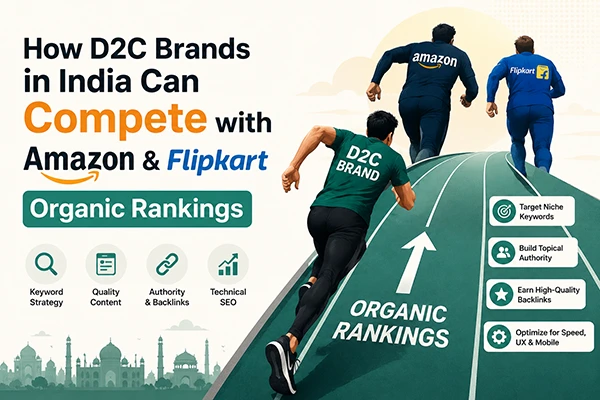
D2C brands in Delhi rarely beat Amazon and Flipkart on broad product keywords, but they can win on brand, long-tail, comparison, and problem-based searches. For example, a Delhi skincare brand may target searches about choosing a moisturizer for dry winters and hot summers, while a food brand may answer questions related to ingredients, storage, and preparation.
According to Unicommerce’s Report 2026, the D2C segment in India recorded 33% growth in order volumes in FY2026 compared with FY2025. This growth gives Delhi D2C brands more room to build their own search presence.
This blog post explores D2C SEO strategies Delhi brands can use, including why marketplaces rank highly, eight SEO steps, Delhi NCR-specific tips, common mistakes, and performance tracking. In the end, you’ll learn how to attract relevant shoppers and improve your chances to rank above Amazon and Flipkart for niche searches.
Key Takeaways:
- According to the India Brand Equity Foundation (IBEF) report, India’s e-commerce market was valued at approximately US$125 billion in 2024 and is projected to reach US$345 billion by 2030. This highlights the growing opportunity for D2C brands to strengthen their online presence.
- Delhi D2C brands can compete with Amazon and Flipkart by targeting specific customer needs, long-tail keywords, and brand-related searches instead of relying only on broad product terms.
- Original product descriptions, strong category pages, useful buying guides, and technical SEO can potentially help improve organic visibility, increasing D2C website traffic.
- Marketplaces can provide brand reach and sales, but an owned website gives greater control over its content, customer experience, and repeat-purchase journey.
- SEO works best when it attracts relevant shoppers while generating revenue, not simply when rankings and traffic increase.
- There is no guaranteed way to outrank a marketplace. The results depend on the website quality, search query, and how well your web page is aligned with the user’s search intent.
- Delhi NCR shoppers search with local needs, such as delivery speed, weather, and festive seasons. Brands that answer these needs can stand out from generic marketplace listings.
Why Amazon and Flipkart Rank So High on Google
Amazon and Flipkart effectively compete in most of the organic searches because they have:
- Extensive product catalogues.
- A large number of relevant landing pages.
- Strong site authority.
- Well-developed internal linking structures.
- Strong brand signals.
- Established, fast-loading websites.
- Informative, useful product/category pages.
However, brands often have the misconception that because Amazon and Flipkart are such large marketplaces, they automatically rank for almost every relevant search query. But that’s not true; platform size doesn’t guarantee search visibility for every product or keyword.
Google Search Central documentation explains how easy-to-navigate site structure, original product data, and crawlable pages help search engines discover, understand, and index an online store’s pages. These factors can influence how relevant a page is to a search query and its potential to rank above Amazon and Flipkart.
Therefore, for small D2C businesses in Delhi, the lesson is straightforward: do not copy a marketplace’s strategies. Compete where your products, customer knowledge, and original content provide a clearer answer.
Where D2C Brands Can Actually Win
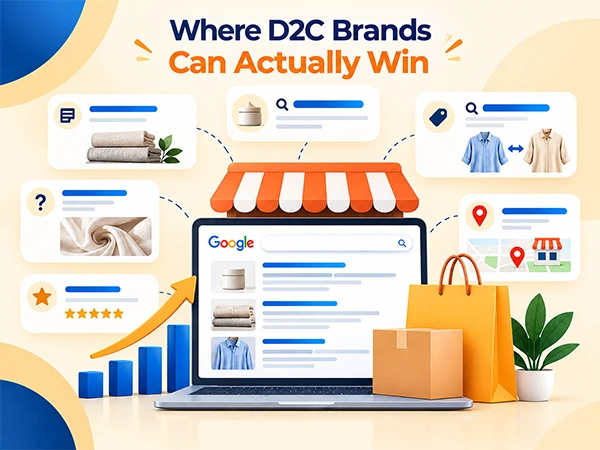
D2C brands have a strong opportunity to rank when a search requires more than a large selection of products. This may involve a specific need, a particular product feature, brand information, or detailed buying decisions.
Here’s an example of how D2C brands can target different types of Google searches and identify SEO opportunities to compete with larger marketplaces like Amazon and Flipkart.
| Search Type | Example Search | Marketplace Strength | D2C Opportunity |
| Broad Product Keyword | Buy Face Moisturizer Online | High | Differentiate through product relevance and brand value. |
| Brand Search | [Brand Name] sunscreen ingredients | Low | Publish authoritative brand and product information. |
| Long-Tail Search | Cotton bedsheets for hot weather | Medium | Explain fabric type, thread count, and care, and link to matching products. |
| Problem-Based Search | How to choose a kurta fabric for summer | Low | Provide expert guidance and relevant product links. |
| Comparison Search | Cotton vs linen shirts for Delhi summers | Low to Medium | Offer a balanced, detailed comparison. |
| Informational Search | How to care for handwoven cotton sarees | Low | Demonstrate category expertise and connect readers to products. |
| Local Search / Example Search | Cotton kurtis in Delhi | Medium | Show Delhi NCR delivery details, local store information, and products suited to local needs. |
Point to Remember: The goal of D2C brand SEO should entirely focus on matching the right page with the precise search intent. For example, a category page may suit a shopper comparing options, while a detailed guide may suit someone researching a problem.
How D2C Brands Can Compete: 8 SEO Steps
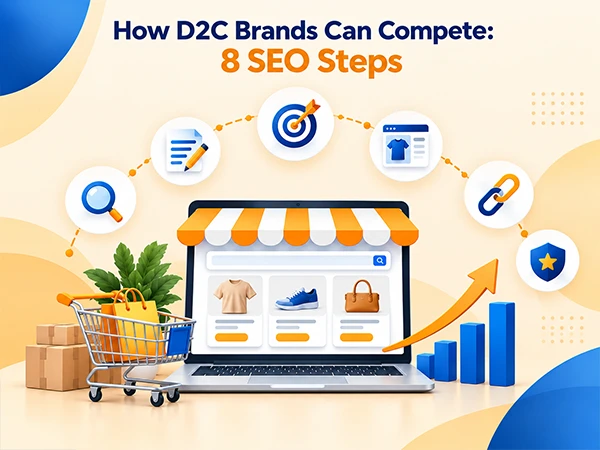
From targeting the right search terms, building strong category pages, and creating a content hub to fixing technical SEO and demonstrating brand signals, in this section we have presented eight D2C SEO strategies. With these steps, you can strengthen your ecommerce SEO, improve online visibility, and attract the right audience.
Review each step below.
Step 1 – Pick Keywords Marketplaces Cannot Own
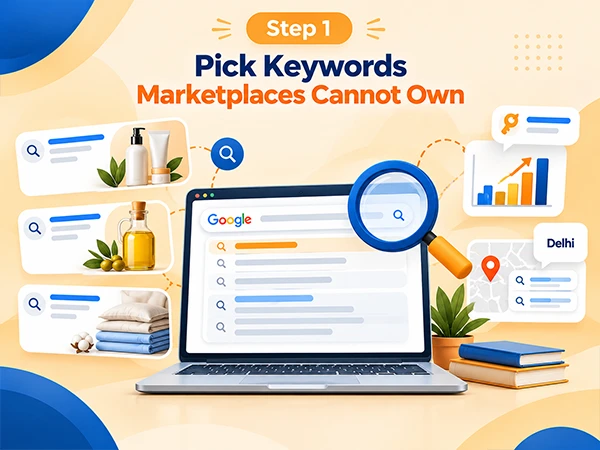
Start by identifying search terms that precisely reflect your product’s unique features, audience, or use case. Avoid broad terms, such as “shoes online” or “face wash”; these keywords are highly competitive and may be difficult for a newer website to win.
Instead, look for more specific searches. For example:
- Skincare: Face cleanser for oily skin in humid weather.
- Food: How to store cold-pressed cooking oil after opening.
- Home Products: Cotton bedsheets for hot climate.
How to do it:
- You can use Google Search Console to identify queries that are already generating impressions.
- Make use of premium or free keyword research tools to compare important insights, like search demand, ranking difficulty, and related terms.
- Review Google’s search results to understand whether shoppers expect product listings, category pages, videos, or informational articles.
- Check searches in Hindi and Hinglish, such as “sasta cotton bedsheet Delhi”, because many Delhi shoppers search this way. Use Google autosuggest and Search Console to confirm.
Point to Remember: Group all the related keywords by intent rather than creating separate pages for each. This will help you avoid duplicate content or unnecessary cannibalization issues.
Step 2 – Build Strong Category Pages
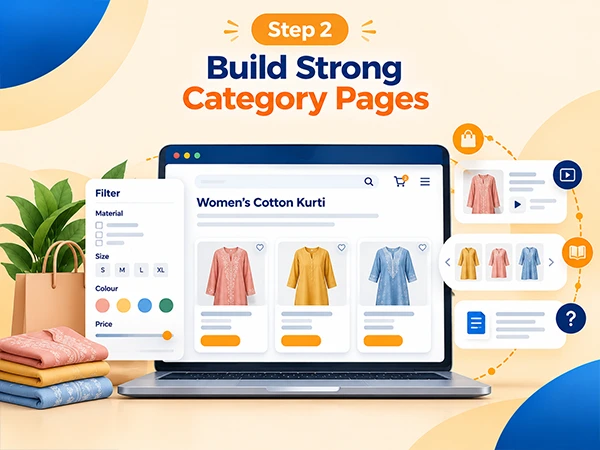
Category pages can help D2C brands target valuable commercial searches because they bring together all the related products and allow visitors to compare options. For example, a page titled “Women’s Cotton Kurti” offers more than a grid of product images, helping shoppers understand what is available and which options suit their needs best.
How to do Category Page SEO:
To build an effective and useful category page, include:
- A clear H1 that accurately describes the category.
- A short description explaining the product and its uses accurately.
- Add relevant filters, such as material quality, size, colour, and price, with relevant unique specifications.
- Product cards with accurate name, image, videos (if applicable), and prices.
- A buying guide explaining the important differences between products.
- Try to link all the relevant subcategories and individual product pages.
- Make sure you answer all genuine customer questions.
Besides the mentioned pointers, technical implementation matters too. Setting filters for categories can create many combinations of URLs, some of which can cause crawling, canonicalisation, and indexing issues.
So, decide which filtered pages deserve indexing and manage unnecessary URL variation. You can also examine Google’s ecommerce website structure guide that thoroughly explains why crawable links between category and product pages matter.
Point to Remember: Avoid adding long, repetitive keyword stuffing in introductions. Ensure the content you demonstrate is not just for ranking; it should help customers make a decision.
Step 3 – Write Product Pages Better Than Marketplace Listings

Product page SEO is not simply about adding more keywords to your content. It is about giving shoppers accurate, complete information about your product that helps them decide whether a product meets their requirements.
For example, a Delhi skincare brand selling a moisturiser can explain the product’s texture, listed ingredients, application instructions, pack size, and benefits instead of repeating a generic description.
How to do it:
- Write a unique product title and description, targeting high-intent, long-tail keywords.
- Include relevant specifications, materials, and ingredients.
- Add original, high-quality product photos from multiple angles.
- Clearly add a product size chart, fit guidance, or care instructions (if applicable).
- Answer common pre-purchase questions.
- Explain shipping, returns, exchanges, and warranties (where relevant).
- Collect genuine customer reviews without fabricated feedback.
- Link to relevant categories, complementary products, and buying guides.
- Add delivery details for Delhi NCR, such as delivery time, pin code check, and cash on delivery (where offered).
Point to Remember: Never copy manufacturer descriptions or marketplace listings without adding meaningful value. Try to add original information that helps shoppers throughout their purchase journey.
Step 4 – Create a Content Hub
Creating a well-structured content hub helps a D2C brand connect all its educational articles, comparison guides, and buying advice to relevant categories and products.
What to Include in a Practical Content Hub:
- Buying guides that explain what customers should consider before making a purchase.
- Comparison articles, providing a thorough differentiation between materials, features, or products.
- Include how-to guides to show readers how to use, maintain, or select the product.
- Add frequently asked questions, addressing recurring customer concerns properly.
- Make sure you include relevant, authentic insights from qualified professionals or people with first-hand experience.
Additionally, try to link each article naturally to the most relevant category or product page. For example, a cloth brand presenting a guide comparing cotton and linen fabrics could internal link to its respective collections.
Point to Remember: Avoid publishing dozens of near-identical articles just to target keyword variations. Google’s guidelines recommend your website content should be useful, reliable, and primarily created for people.
Step 5 – Own Your Brand Searches
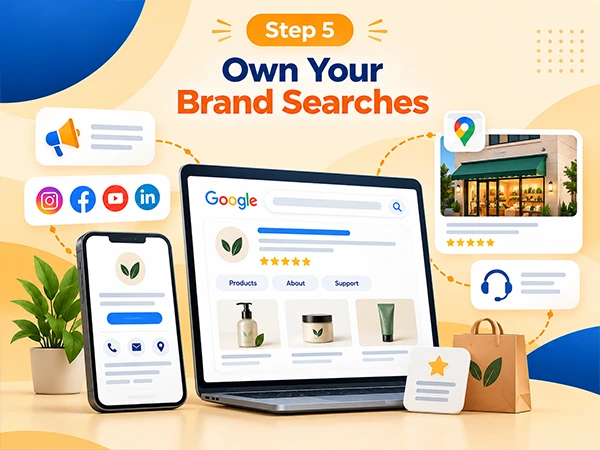
Brand-related searches can be very valuable because the users may already know your business or have encountered it elsewhere. Thus, your website should make it easy for people searching for your brand to find official information, products, contact details, and customer support.
How to do it:
- Create a clear homepage that explains what your brand particularly sells.
- Maintain accurate product and category information.
- Precisely provide an accessible “About Page” and “Customer Support” details.
- Link the website to official social media profiles.
- Mention consistent store locations and contact information.
- Implement relevant structured data, such as Organization and Product markup (where appropriate).
- Earn genuine mentions through industry coverage, partnerships, and public relations.
Additionally, if your D2C business has physical stores or serves customers locally, maintain an eligible, accurate Google Business Profile.
Point to Remember: D2C brand SEO or structured data purpose is to help search engines understand eligible information; display and ranking outcomes are not guaranteed.
Step 6 – Build Trust Signals

Online shoppers need confidence in both the product and the seller. Your clear policies, accurate claims, and easily accessible customer support can reduce purchase uncertainty, improve the shopping experience, and help convert D2C website traffic into sales.
What to Add:
- Genuine customer reviews and ratings.
- Clear shipping, return, refund, and exchange policies.
- Secure payment options and a reliable checkout process.
- Relevant certifications, with their scope and validity explained.
- A genuine company story and identifiable customer support channels.
- Evidence supporting product claims (where appropriate).
- Delivery timelines and return policy for Delhi NCR orders.
For example, an Indian packaged food brand selling millet snacks should clearly list ingredients, allergens, nutritional information, storage instructions, and applicable FSSAI licence details.
Point to Remember: Trust cannot be built by adding badges alone. It takes consistent effort and verifiable information throughout the buying journey. Also, if you use review structured data, ensure it precisely follows Google’s structured data guidelines.
Step 7 – Fix Technical SEO for Ecommerce
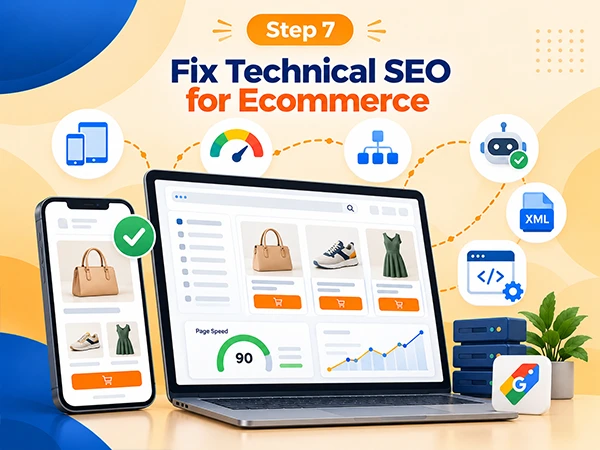
Google’s Search Engine Optimization (SEO) starter guide states that even useful, well-structured content may struggle to perform if search engines cannot crawl, understand, or index the relevant pages correctly.
How to do it:
To perform a technical SEO audit, review the following areas attentively:
- Ensure your product images, filters, navigation, and checkout work smoothly on small screens.
- Measure Core Web Vitals and prioritize improvements that affect real user experience.
- Make sure all important category and product pages are easy to reach through standard links.
- Check that valuable pages are indexed, and keep unwanted URLs out of the index using noindex or canonical tags.
- Use consistent canonical URLs for duplicate or very similar pages.
- Mark up accurate product information where eligible.
- Create an XML sitemap that includes the important pages you want search engines to discover.
- Control the crawl and indexation impact of filters and sorting parameters.
- Optimize oversized images, unnecessary scripts, and other avoidable delays.
- Set up Google Merchant Center so your products can appear in free product listings and Google Shopping results (where eligible).
Use Google Search Console to monitor indexing, search performance, and technical issues. Also, to investigate performance, you can use PageSpeed Insights.
Step 8 – Earn Links and Brand Mentions

Quality links and genuine brand mentions can help people discover your business and provide useful context about your products. For D2C brands, link earning should focus on activities that offer real value rather than schemes designed to manipulate rankings.
What Approaches You Can Include:
- Try to share original research, product innovations, or useful industry insights with relevant publications.
- Focus on working with creators who can independently review or explain products to their audiences.
- Offer relevant expertise to publications covering fashion, food, beauty, or home products.
- Publish surveys or customer research with clear methods and stated limitations.
- Seek legitimate listings and partnerships relevant to your category.
- Aim to create size guides, material comparisons, or care resources that other websites may naturally reference.
- Connect with Delhi-based creators, bloggers, and local publications that cover your category.
For example, a home-textile brand could publish an evidence-based guide to fabric care and offer it as a resource to interior design publishers.
Point to Remember: Do not buy links to manipulate rankings. Prioritize relevance, editorial integrity, and the value delivered to readers.
D2C SEO Tips for Delhi NCR Brands
Delhi NCR shoppers compare brands against Amazon, Flipkart, and quick-commerce apps like Blinkit and Zepto. A D2C website can stand out by answering local needs that these platforms do not explain well. Use the tips below.
| Delhi Factor | What to Do on Your Website |
| Quick delivery expectations | Show clear delivery timelines for Delhi NCR (Delhi, Noida, Gurugram, Ghaziabad, Faridabad) on product pages and in the footer. |
| Weather and seasons | Publish guides tied to Delhi seasons, such as winter skincare, summer fabrics, and festive gifting. Update them before each season. |
| Festive and wedding seasons | Create category pages for Diwali, Karwa Chauth, and wedding shopping. Keep the URLs permanent, and update the content every year. |
| Air quality concerns | If your products relate to skin, home, or health, publish helpful content about Delhi’s air quality. Do not make medical or unproven claims. |
| Local language searches | Add Hindi or Hinglish terms where they fit naturally in titles, FAQs, and descriptions. |
| Local presence | If you have a Delhi store or pickup point, add it to your Google Business Profile and website, with consistent name, address, and phone details. |
Point to Remember: Do not create dozens of near-identical “[product] in [Delhi area]” pages. Create a local page only if it has real, useful information, such as delivery details or a store location.
Should D2C Brands Stay Off Marketplaces?
No, D2C brands should treat marketplaces and their own website as complementary channels, not mutually exclusive. For instance, you can use a hybrid strategy that leverages marketplaces for discovery and scale while driving repeat business through your website.
Below, we have presented a table for marketplace vs. your own website, explaining how you can use both platforms simultaneously without losing control of your D2C brand.
| Factors | Selling on Marketplace | Selling on Your Own Website | Best Strategy for D2C Brands |
| Customer Reach | Access shoppers who are already browsing platforms like Amazon or Flipkart. | Requires investment in SEO, paid advertising, and social media. | Use marketplaces to reach new, more potential customers and SEO to build long-term D2C website traffic. |
| Competition | Compete your products with other alternatives that may appear alongside. | Greater control over your product presentation without any competitor listing on the same page. | Compete on the marketplace through product price and quality, while highlighting its unique benefits on your website. |
| Customer Relationship | Direct customer communication and data access are subject to marketplace policies. | Enables consent-based email marketing, loyalty programmes, and personalized communication. | Use the permitted marketplace to interact with new customers and your website to build a direct relationship. |
| Branding | Branding options depend on platform features and listing rules. | Greater control over website design, product description, and shopping experience. | Use the marketplace for product discovery and your website to perfectly represent your brand’s identity. |
| Selling Costs | May include different marketplace fees, like commissions, advertising, discounts, and return costs. | May include hosting, payment processing, logistics, marketing, and technology expenses. | Compare net profit per order after accounting for all channel-specific costs. |
| Repeat Purchases | Reordering depends on customer behaviour and marketplace features. | Supports retention campaigns, loyalty rewards, and replenishment reminders. | Build repeat-purchase and loyalty programmes on your website while following marketplace policies. |
| Long-Term Growth | Growth depends partly on marketplace visibility, competition, fees, and particular platform policies. | Supports independent brand building but requires sustained investment in traffic and customer retention. | Diversify sales channels to reduce dependence on a single platform. |
Consequently, a practical strategy is to use marketplaces to reach relevant shoppers while building an owned website for deeper product branding, discovery, and repeat purchases.
How AI Search Impacts D2C SEO
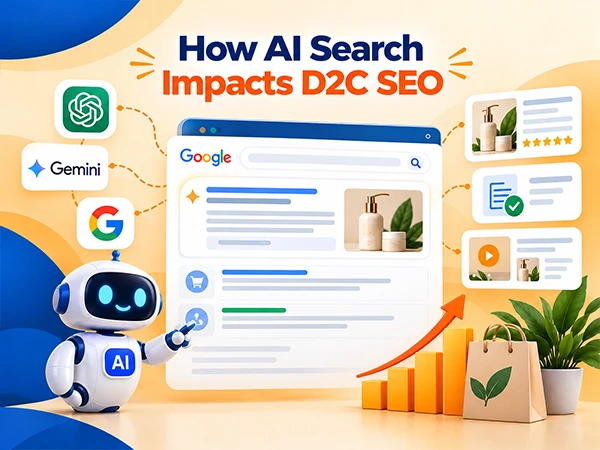
AI-powered search features are changing how shoppers discover products and get information online. Instead of only scrolling through traditional blue links, many shoppers now use AI tools such as ChatGPT, Gemini, and Google AI Overviews that summarize information from multiple sources.
However, Google Search Central documentation states that established SEO practices remain relevant for AI features in Search. Your page must meet Google’s technical requirements to be eligible to appear in search results and AI-generated responses.
Note: Neither SEO nor any other optimization practice guarantees search engine positioning or inclusion in AI-powered responses. These practices optimize your content and increase the chances of getting ranked or appearing in AI systems.
For D2C brands, to get your product or brand cited, mentioned, or recommended by AI systems, focus on:
- Optimize your content for generative engine optimization by providing clear, authoritative, and well-structured information that AI-powered search engines can easily discover, understand, and reference.
- Provide original information that goes beyond competitors or generic descriptions.
- Include accurate product specifications and transparent policies.
- Ensure relevant, effective link-building between guides, categories, and product pages.
- Make sure you add credible authorship and appropriate expert review to boost your credibility.
- Include helpful images, videos, and demonstrations where they add value to your content.
- Use structured data that matches visible page content.
For example, a D2C food brand can compare different cooking oils by explaining their ingredients, nutritional values, smoke points, and best uses. This will help them increase the chances of their content being cited or their product being recommended by AI systems in response to relevant queries.
Common D2C SEO Mistakes to Avoid
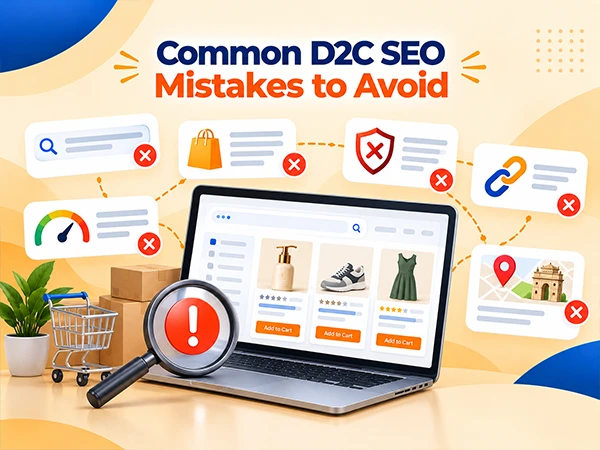
Here are some common mistakes D2C brands should avoid when building their SEO strategy.
- Focusing exclusively on broad keywords increases competition and misses long-tail searches that generally reflect specific customer needs and purchase intent.
- Reusing generic product descriptions limits product originality, weakens differentiation, and reduces opportunities to provide unique information that attracts shoppers instantly.
- Making unverified claims about product benefits, ingredients, or performance damages your brand credibility and can mislead customers.
- Purchasing links just to manipulate search rankings violates Google’s spam policies and can potentially expose your website to ranking penalties.
- Failing to interlink relevant blogs, category pages, and products makes navigation harder and may prevent search engines from discovering important pages.
- Slow-loading pages can leave shoppers frustrated, increasing bounce rates, reducing conversions, and negatively affecting user experience, especially on mobile devices.
- Targeting only “India” keywords misses Delhi NCR shoppers who search with local intent, such as delivery in Delhi or products suited to local weather.
How to Track D2C SEO Performance
You can use Google Search Console to track your website clicks, impressions, CTR, and search queries. Similarly, to analyze organic conversions, revenue, and the customer journey, make use of Google Analytics 4.
Below, we have presented a simple table highlighting the key D2C SEO metrics to measure and how brands can use them to evaluate their search performance and business growth. Take a look.
| Metric to Track | What it Measures | How D2C Brands Should Use It |
| Organic Clicks | Clicks from Google Search to your website | Identify pages driving traffic and investigate declines or growth. |
| Search Impressions | How often your website appears in search results | Find relevant queries where your brand has visibility but needs to improve rankings. |
| Click-Through Rate (CTR) | Percentage of impressions that turn into clicks. | If CTR is lower than expected, improve your page titles and meta description. |
| Non-Brand Clicks | Clicks from searches that do not include your brand name. | Measure how effectively your website attracts new customers through category and problem-based searches. |
| Category and Product Performance | Organic traffic to commercial pages. | Identify which product and category pages need better content, internal links, or optimization. |
| Organic Revenue | Revenue attributed to organic search. | Evaluate SEO’s contribution to sales, acquisition costs, and profit margins. |
| Organic Conversions | Purchases or other conversions that come from organic search | Assess whether organic visitors are turning into customers. |
| Delhi NCR Traffic | Organic visits from Delhi and nearby cities | Check the city report in Google Analytics. In Search Console, filter queries containing “Delhi” or “NCR”. Compare conversions with other cities. |
Conclusion
In a nutshell, Delhi D2C brands do not need to rank above Amazon and Flipkart on every keyword to build a successful organic search channel. They need to understand their targeted customers’ search intent, create better product and category pages, and maintain a technically healthy website. Notably, use the marketplaces where they support your business, while developing your own website as a valuable, useful destination for shoppers.
Besides, if you need professional help to build an ecommerce SEO roadmap, improve product page SEO, or resolve technical issues, explore our ecommerce SEO services in Delhi or learn how a D2C SEO company in Delhi can support your brand.
Frequently Asked Questions
Can a D2C brand outrank Amazon and Flipkart on Google?
Yes, for some queries D2C brands can rank above Amazon and Flipkart on Google, but not consistently across every product search. For instance, a D2C brand may be more relevant for a branded query, a specific use case, or a detailed buying guide, whereas broad keywords can be harder to win.
Why do marketplaces rank so high?
Marketplaces like Amazon and Flipkart can rank high on search engine result pages because they match high buying intent, have large product catalogues, strong site authority, many reviews, and strong internal linking.
How can D2C brands get organic traffic without marketplaces?
To increase D2C website traffic, try to build your entire SEO and content strategy around your own website. For example, target relevant category and product keywords, publish useful content, improve internal linking, maintain technical SEO, and earn legitimate brand mentions. Besides, track key performance metrics, such as non-brand organic clicks and conversions, to understand whether you are reaching shoppers beyond brand awareness.
Is SEO better than paid ads for D2C brands?
Neither SEO nor paid ads are universally better for D2C brands. Paid advertising can generate visibility quickly while campaigns are active, whereas SEO can build sustainable organic visibility over time.
How much does D2C SEO cost in India?
D2C SEO costs in India vary by website size, competition, technical needs, content, link building, and scope. Many SEO agencies charge around ₹20,000–₹1,00,000+ per month. Contact us for a custom quote based on your goals.